
There’s a quiet myth floating around the AI space:
“If I just write the perfect, ultra-detailed prompt… I’ll get perfect results.”
Sounds good. Feels smart.
But in practice?
It’s a trap.
Because the people getting real results with AI aren’t the ones writing massive prompts.
They’re the ones executing fast, iterating, and finishing work.
The Prompt Length Illusion
You’ve seen it:
- Giant, multi-paragraph prompts
- Over-specified instructions
- Endless constraints and conditions
It feels like control.
But what it usually creates is:
- Slower output
- More confusion
- Less flexibility
- More time spent thinking instead of doing
A long prompt doesn’t make you productive. It often makes you stuck.
What Actually Works
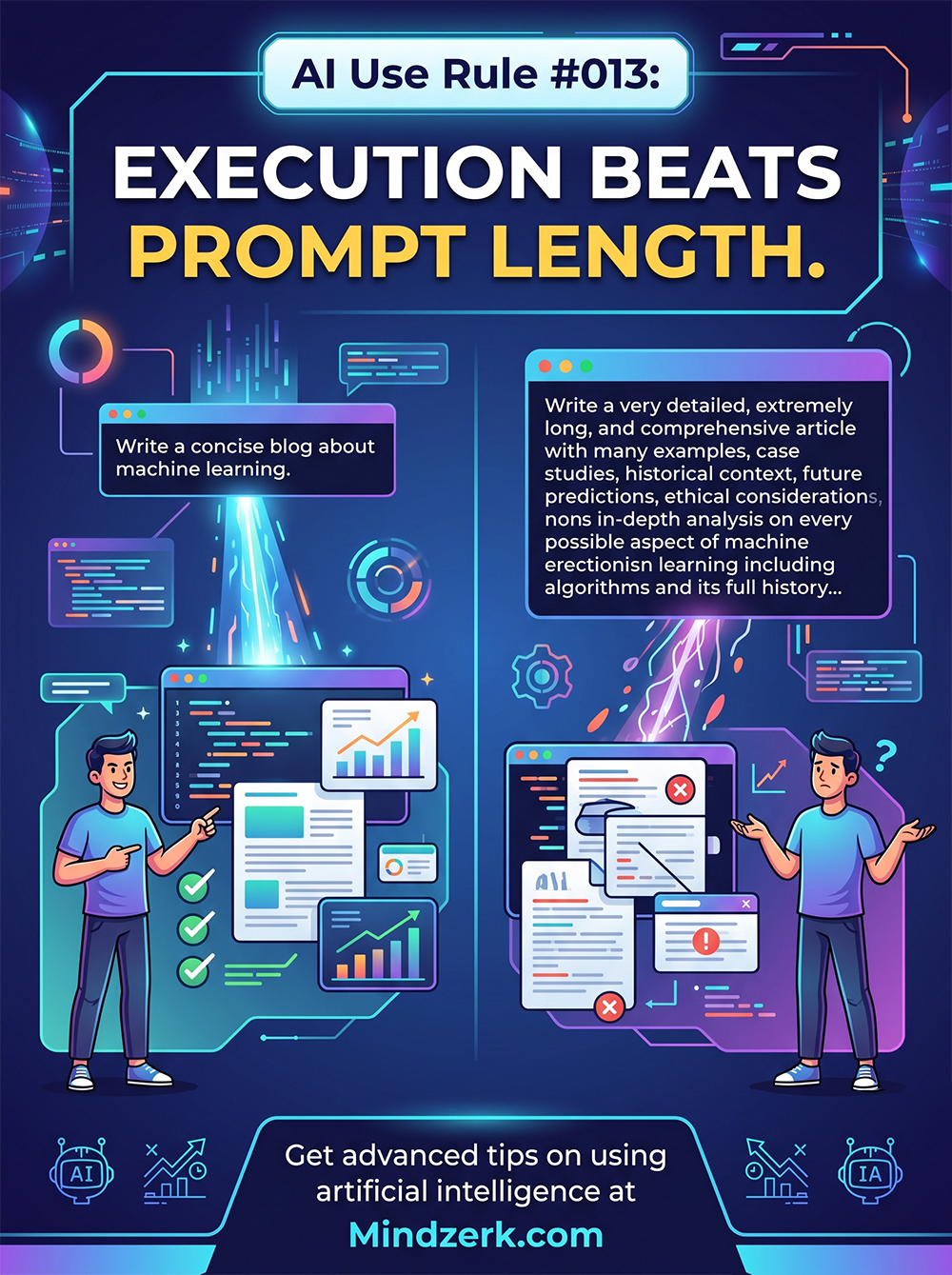
Simple input. Fast output. Rapid refinement.
That’s the real loop.
Instead of:
“Write a 5,000-word comprehensive, deeply researched, multi-angle breakdown with examples, frameworks, case studies, and…”
Try:
“Write a short blog post about X.”
Then:
- Refine
- Expand
- Adjust
- Improve
Why Execution Wins
1. Speed Creates Momentum
Short prompts get results immediately.
Momentum builds confidence.
Confidence leads to output.
2. Iteration Beats Perfection
Your first result doesn’t need to be perfect.
It needs to exist.
From there, you:
- Edit
- Shape
- Guide
AI works best as a collaborator—not a one-shot answer machine.
3. You Stay Flexible
Long prompts lock you into assumptions.
Short prompts let you pivot.
You can:
- Change direction
- Adjust tone
- Explore variations
Without rewriting everything.
4. Output > Input
Most people spend 80% of their time crafting prompts…
And 20% actually using the output.
High performers flip that.
They spend less time asking—and more time building.
The Real AI Advantage
It’s not intelligence.
It’s speed of execution.
- Faster drafts
- Faster decisions
- Faster iterations
- Faster completion
The edge isn’t knowing more.
It’s moving faster than everyone else.
What Bad AI Use Looks Like
Let’s be honest.
Overthinking the Prompt
Trying to engineer perfection upfront.
Result: Delay.
Expecting One-Shot Perfection
Hoping the AI nails everything in one go.
Result: Frustration.
Treating AI Like a Final Answer
Instead of a tool for building.
Result: Stagnation.
What Good AI Use Looks Like
1. Start Simple
Give a clear, basic instruction.
Get something on the page.
2. Refine in Layers
Improve step by step:
- Add detail
- Adjust tone
- Fix structure
3. Use Output as Fuel
Every response becomes the next input.
That’s the loop.
4. Finish the Work
Most people stop at “good enough.”
Execution-focused users:
- Polish
- Format
- Ship
That’s where the value is.
A Simple Workflow
Use this instead of overbuilding prompts:
- Start: “Write a short version of X.”
- Expand: “Add more detail to section Y.”
- Refine: “Make this clearer and more direct.”
- Polish: “Format this for publishing.”
- Ship.
That’s it.
The Hidden Cost of Over-Prompting
Every extra minute spent crafting the “perfect” prompt is a minute not spent:
- Publishing
- Testing
- Selling
- Improving
And in fast-moving environments…
That cost adds up fast.
The Real Skill
It’s not prompt writing.
It’s decision making and follow-through.
Knowing:
- What to keep
- What to cut
- What to improve
- When to ship
Final Thought
You don’t need better prompts.
You need better execution.
Short prompts. Fast output. Constant refinement.
That’s how you win with AI.
Stop trying to impress the machine.
Start using it.
And most importantly—finish what you start.