
AI is powerful.
That’s exactly why you should be careful with it.
Most people are racing to automate everything, outsource their thinking, and hand over more decisions to systems they barely understand.
That works… until it doesn’t.
AI should make you stronger.
Not dependent.
The Trap Nobody Talks About
AI feels effortless.
- Instant answers
- Instant content
- Instant ideas
- Instant execution
And slowly, without noticing, people stop:
- Thinking deeply
- Learning fundamentals
- Solving problems independently
- Building real skill
Convenience becomes dependency.
Dependency becomes fragility.
AI Is a Multiplier — Not a Replacement
AI works best when it enhances human capability.
Not when it replaces it completely.
The strongest operators use AI to:
- Speed up workflows
- Explore ideas
- Expand leverage
- Reduce repetitive work
But they still:
- Think critically
- Verify outputs
- Make final decisions
- Understand the systems underneath
Keep the human brain in the driver’s seat.
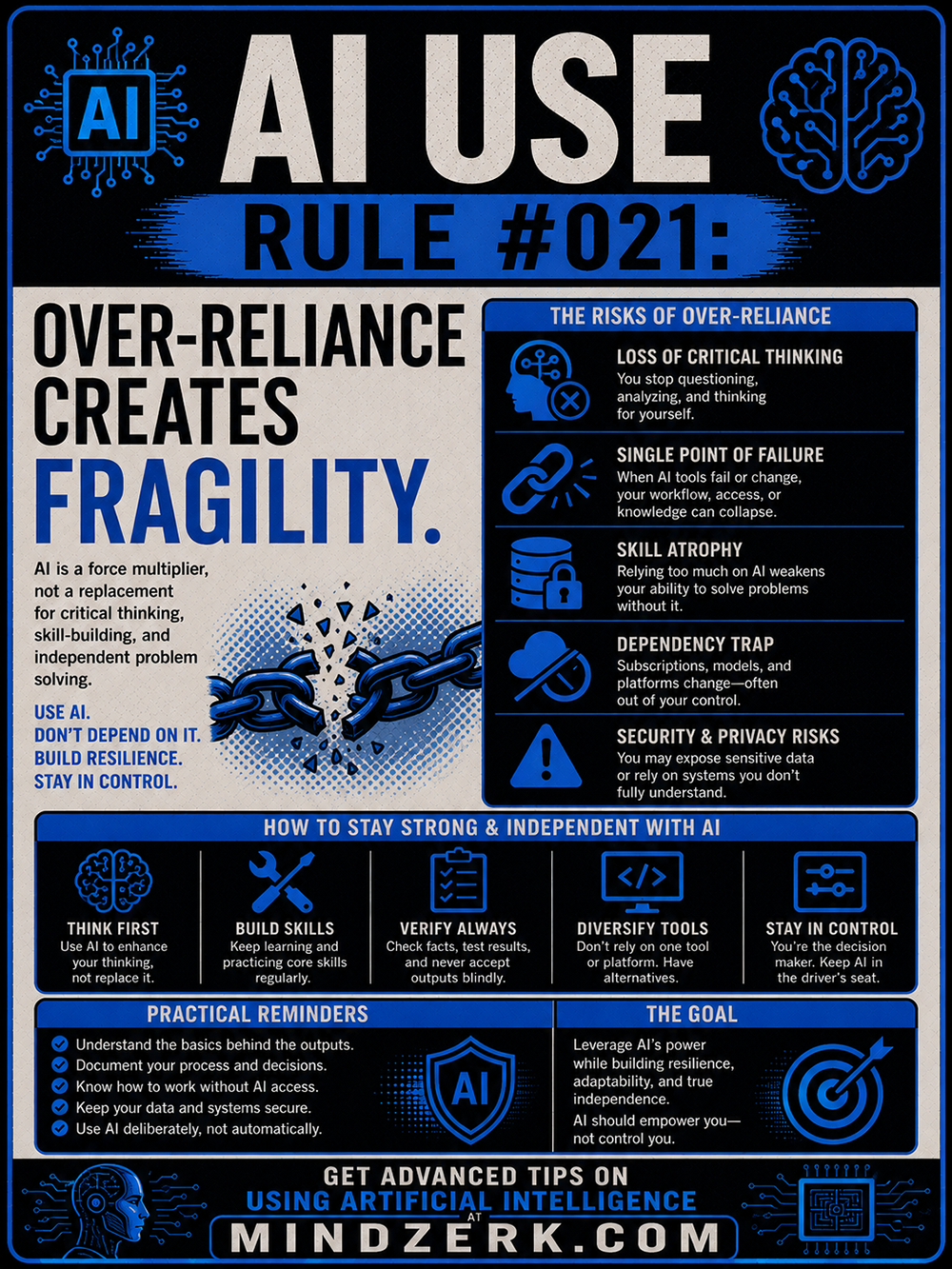
The Risks of Over-Reliance
Loss of Critical Thinking
If AI answers everything for you, your ability to analyze weakens.
You stop questioning.
You stop testing.
You stop thinking independently.
That’s dangerous.
Single Point of Failure
What happens when:
- The tool changes?
- Pricing changes?
- Access disappears?
- The output quality drops?
If your entire workflow depends on one platform, you don’t own your system.
Skill Atrophy
Skills decay when unused.
If AI writes everything, plans everything, and solves everything…
Eventually you can’t operate without it.
Dependency Traps
Subscriptions change.
Platforms disappear.
Policies shift.
The more dependent you become, the less control you actually have.
Security & Privacy Risks
Many people dump sensitive information into systems they don’t fully understand.
That’s a mistake.
Convenience should never replace awareness.
How to Stay Strong With AI
Think First
Use AI to support your thinking—not replace it.
Don’t ask:
“What should I think?”
Ask:
“Help me explore this better.”
Build Real Skills
Keep practicing core abilities:
- Writing
- Research
- Communication
- Problem solving
- Strategy
AI should sharpen your edge, not dull it.
Verify Everything
Never blindly trust outputs.
Check:
- Facts
- Logic
- Accuracy
- Context
AI can sound confident while being wrong.
Diversify Your Tools
Don’t rely on one system.
Have alternatives.
Learn multiple workflows.
Build flexibility into your operation.
Stay in Control
You make the final call.
Not the model.
Not the automation.
Not the algorithm.
Practical Habits That Matter
Understand the Basics
If you don’t understand the fundamentals behind the output, you’re vulnerable.
Document Your Decisions
Know:
- Why you chose something
- What worked
- What failed
This builds long-term intelligence.
Know How to Work Without AI
This is critical.
Could you still function if your favorite AI tool disappeared tomorrow?
If the answer is no, fix that.
Protect Your Data
Be careful what you upload.
Not every system deserves your trust.
Use AI Deliberately
Don’t automate just because you can.
Use it with purpose.
The Bigger Picture
The goal isn’t to reject AI.
That’s stupid.
The goal is resilience.
You want:
- Speed without dependency
- Leverage without weakness
- Automation without surrender
That balance matters.
The Strongest Position
The strongest person in the AI era is not the one who depends on AI the most.
It’s the person who can:
- Use AI effectively
- Think independently
- Adapt quickly
- Operate with or without the tools
That’s real power.
The Bottom Line
AI is a force multiplier.
Treat it like one.
- Use it
- Learn from it
- Leverage it
- Scale with it
But don’t hand over your mind.
Because over-reliance creates fragility.
And fragile systems eventually break.
Build resilience.
Stay adaptable.
Stay in control.