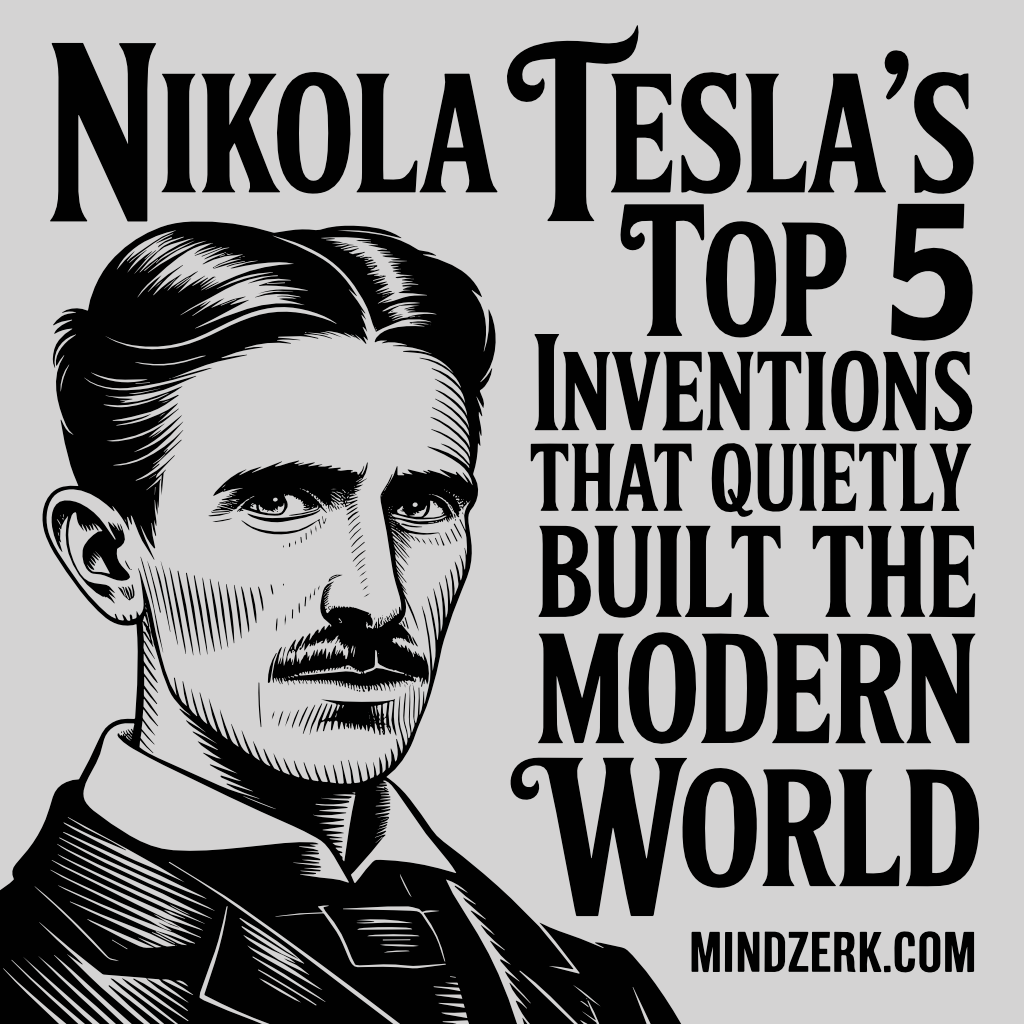

Nikola Tesla has become a meme.
Lightning bolts. Free energy. Mad scientist energy drink branding. Internet conspiracy saint.
But behind the myth is something far more interesting: Tesla didn’t just invent gadgets — he designed systems that reshaped how reality flows around us.
He built invisible infrastructure.
Here are five of his most powerful inventions — not ranked by popularity, but by how deeply they rewired civilization.
1. The Alternating Current (AC) Power System — The Invisible Grid
Before Tesla, electricity was local.
Thomas Edison pushed direct current (DC), which worked — but only over short distances. Cities would have needed small power stations every few blocks.
Tesla’s alternating current system changed everything.
Why it mattered:
- AC could travel long distances with minimal loss.
- Voltage could be stepped up and down using transformers.
- Power generation centralized. Distribution expanded.
This wasn’t just an invention — it was a planetary nervous system.
Every outlet you plug into today is part of Tesla’s architecture.
The so-called “War of Currents” wasn’t about light bulbs. It was about who controlled the flow of civilization itself.
2. The Induction Motor — Turning Electricity Into Motion
Tesla didn’t just move electricity.
He made it move machines.
The induction motor uses rotating magnetic fields to create motion without brushes or commutators — meaning fewer moving parts, less wear, and massive efficiency gains.
Why it mattered:
- Industrial machinery became more reliable.
- Factories scaled faster.
- Electric appliances became practical.
Your washing machine. Your HVAC system. Many industrial machines.
They’re descendants of Tesla’s rotating magnetic field idea.
It’s one of the quiet engines of modern industry.
3. Radio Technology — The Signal That Changed Everything
History gave radio credit to Guglielmo Marconi.
But decades later, courts recognized Tesla’s earlier patents as foundational to radio transmission.
Tesla envisioned wireless communication long before society was ready for it.
Why it mattered:
- Wireless transmission became possible.
- Information detached from wires.
- Communication shifted from physical infrastructure to electromagnetic space.
Radio wasn’t just broadcasting.
It was the first step toward Wi-Fi, cellular networks, GPS, and the always-on signal environment we now live inside.
Tesla saw the world becoming a connected nervous system.
He wasn’t wrong.
4. The Tesla Coil — More Than Lightning Showmanship
The Tesla coil is often dismissed as a science-fair spectacle.
That’s a mistake.
It was a laboratory tool that allowed high-frequency, high-voltage experimentation — opening the door to technologies that needed controlled electrical oscillations.
Why it mattered:
- Early research into wireless power transfer.
- Foundations for radio-frequency transmission.
- Experimental groundwork for modern electronics.
The coil allowed scientists to explore new ranges of energy behavior.
Think of it as a key that unlocked electrical frequencies previously inaccessible.
5. Wireless Energy Vision — The Idea That Still Haunts Engineers
Wardenclyffe Tower never reached completion.
Many call it a failure.
But the concept behind it remains one of Tesla’s most radical contributions: transmitting power without wires.
Tesla believed Earth itself could act as a conductor.
Why it mattered:
- Inspired modern wireless charging technologies.
- Influenced remote power transmission research.
- Changed how engineers think about energy distribution.
Even if Tesla’s original global wireless energy dream proved impractical at scale, the core idea continues to shape research.
Sometimes the invention isn’t the finished machine — it’s the conceptual horizon that pulls technology forward.
Why Tesla Still Matters
Tesla wasn’t just building machines.
He was attempting to redesign how energy, information, and motion flow through society.
His legacy is paradoxical:
- Overhyped in mythology.
- Underrated in actual systemic impact.
We live inside systems he imagined before vacuum tubes, before silicon chips, before the digital age.
And most people never notice.
Which is probably exactly how true infrastructure works.
Outlaw Science No. 1 — Tesla’s Death Ray
Before laser weapons, before missile defense systems, before the modern obsession with directed energy — Nikola Tesla claimed to have designed a weapon so powerful it could end war itself.
He called it the Teleforce.
The press called it the “Death Ray.”
In this first issue of Outlaw Science, we dig into one of the most controversial and misunderstood inventions ever proposed. Was Tesla building a superweapon… or something far stranger? Drawing from historical records, engineering theory, government interest, and decades of speculation, this report separates myth from mechanism while exploring why the idea refuses to die.
Inside:
- The real science behind Tesla’s directed-energy concept
- What Tesla actually claimed vs. what newspapers invented
- Why multiple governments quietly expressed interest
- The physics that might make parts of it possible today
- How the Death Ray fits into Tesla’s larger vision of technological deterrence
This isn’t conspiracy. It’s an excavation.
Outlaw Science No. 1 opens the vault on the edge where visionary engineering meets forbidden imagination — and asks a question few are willing to explore:
Was Tesla trying to build a weapon… or redesign the rules of power itself?