
Look at that image.
That’s not just mesh and citrus pulp—it’s a reminder of something most people overlook until it’s too late:
Systems fail. Simple backups don’t.
The Problem Nobody Plans For
If you’re running any kind of off-grid setup—or even just trying to be more self-reliant—you’ve probably leaned on at least one of these:
- Electric water pumps
- Pressurized plumbing systems
- Filters that need force or suction
They work great… until they don’t.
Cold snaps freeze lines.
Sediment clogs filters.
Power hiccups kill pumps.
And suddenly, your “solid” system turns into dead weight.
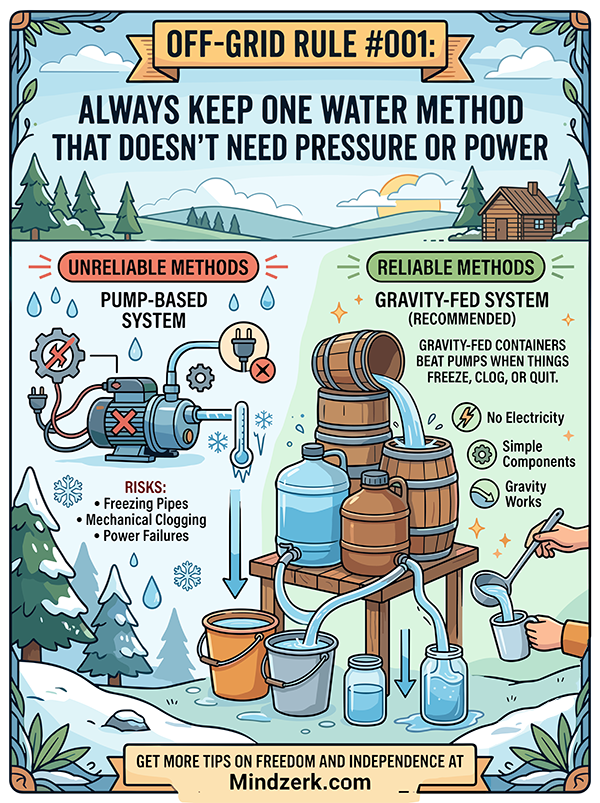
The Rule: Always Have One Passive Water Method
Here’s the move:
Always keep one water method that doesn’t rely on pressure or power.
No electricity.
No moving parts.
No dependencies.
Just gravity doing what it’s always done.
Why Gravity Wins Every Time
Gravity-fed systems don’t care about your situation.
- No power? Still works.
- Frozen pump? Doesn’t matter.
- Low pressure? Irrelevant.
If water is higher than the outlet, it flows. That’s it.
That simplicity is what makes it bulletproof.
What This Looks Like in Real Life
You don’t need anything fancy.
A basic setup can be:
- A container elevated above your use point (table, rack, tree branch)
- A spigot or simple outlet at the bottom
- A basic filter bag or cloth (like what you’re seeing in the image)
That’s enough to:
- Rinse food
- Wash hands
- Gravity-filter questionable water
- Keep things moving when everything else stalls
The Hidden Advantage: It Slows You Down (In a Good Way)
There’s something else people don’t talk about.
Gravity systems force a different pace.
You start thinking ahead:
- “Do I have enough filled?”
- “Where’s my next source?”
That mindset shift is what separates scrambling from being prepared.
Where Most People Go Wrong
They overbuild.
They stack complexity on top of complexity:
- Pumps
- Backup pumps
- Battery systems
- Pressure regulators
All of that has its place.
But none of it replaces a dumb, simple, always-works fallback.
The Bottom Line
You don’t need to ditch your main system.
Just make sure you’ve got one thing in place that ignores failure completely.
If everything breaks… you still have water.
That’s the line that matters.
If you’re building out more of these systems—survival, privacy, money, whatever—keep the same rule in mind:
Have one version that still works when everything else doesn’t.
That’s how you stay in control.