
Most people blame AI when the real problem is the prompt.
They type vague instructions like:
- “Write a blog post.”
- “Give me ideas.”
- “Help me market my business.”
Then they get generic output and conclude the tool is overrated.
That’s not an AI problem. That’s an input problem.
AI is a pattern engine. The clearer your direction, the more useful the output becomes. Specific prompts create specific results because specificity reduces ambiguity. The AI stops guessing and starts executing.
The difference between mediocre output and high-value output is often just better instructions.
Vague In = Vague Out
A vague prompt forces the AI to make assumptions:
- Who is this for?
- What tone should it use?
- How long should it be?
- What outcome matters?
- What format is needed?
- What examples should it include?
The model fills those gaps with averages.
Average instructions create average outputs.
That’s why so many people using AI end up sounding identical. They’re giving shallow prompts and getting statistically safe responses back.
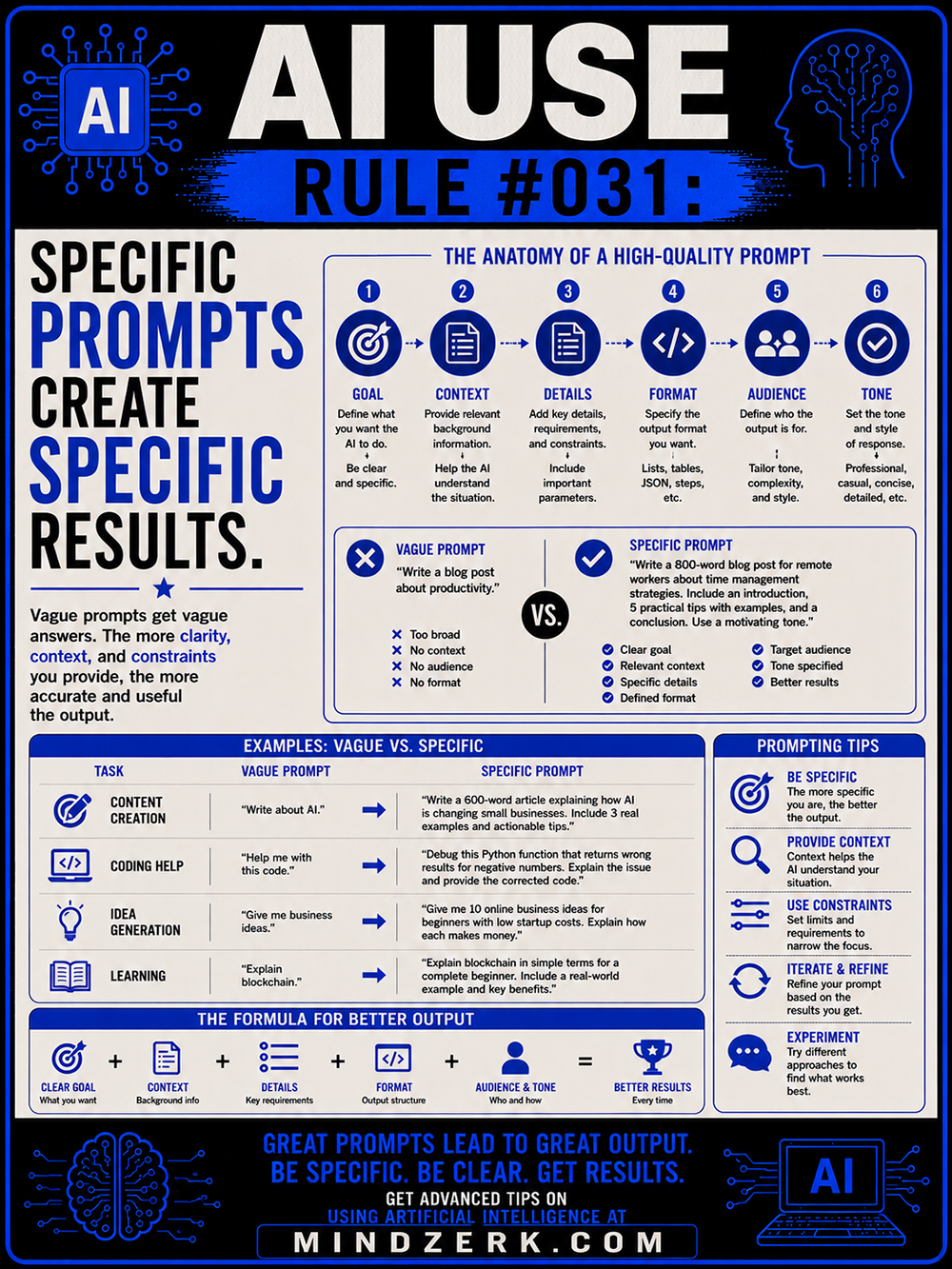
The Anatomy of a High-Quality Prompt
A strong prompt usually contains six things:
1. Goal
Tell the AI exactly what success looks like.
Bad:
“Write about productivity.”
Better:
“Write a 1,000-word blog post teaching remote workers how to manage distractions while working from home.”
Clarity changes everything.
2. Context
Background matters.
Explain:
- the business
- the audience
- the purpose
- the situation
- the platform
The more relevant context you provide, the better the AI can align the output.
AI without context is like hiring someone blindfolded.
3. Details
Add constraints and specifics.
Include things like:
- word count
- tone
- formatting
- examples
- target audience
- style references
- structure requirements
Specificity narrows the output toward usefulness.
4. Format
Tell the AI how the information should be delivered.
Examples:
- bullet points
- step-by-step guide
- JSON
- checklist
- infographic copy
- tweet thread
- sales page
- email sequence
Format dramatically affects usability.
5. Audience
Different audiences require different language.
A beginner needs:
- simplicity
- examples
- explanations
An expert needs:
- precision
- speed
- depth
Define who the output is for.
6. Tone
Tone changes perception.
Examples:
- direct
- motivational
- professional
- aggressive
- minimalist
- humorous
- technical
- conversational
AI can adapt remarkably well when tone is clearly defined.
Why Most People Fail With AI
Most users:
- under-explain
- skip context
- avoid specifics
- provide no constraints
- fail to refine outputs
Then they expect world-class results from one sentence.
That’s like walking into a machine shop and saying:
“Build me something cool.”
Professionals give specifications.
Prompting Is a Skill
People act like prompting is cheating.
It’s not.
Prompting is communication.
And communication has always been valuable.
The ability to:
- define goals
- structure ideas
- clarify outcomes
- guide systems
- refine results
…is a real-world skill that compounds across every industry.
Good prompting is structured thinking.
The Real Advantage
The future advantage won’t belong to people with access to AI.
Everyone will have access.
The advantage belongs to people who can:
- think clearly
- communicate precisely
- structure workflows
- refine outputs
- build repeatable systems
That’s why specific prompting matters.
It’s not about “tricking” the AI.
It’s about directing leverage.
Simple Prompt Upgrades That Instantly Improve Output
Instead of:
“Write me a sales page.”
Try:
“Write a 700-word sales page for a beginner survival gardening guide aimed at suburban homeowners. Use a direct, practical tone. Focus on reducing grocery bills and building food independence. Include a headline, subheads, bullets, and a strong call to action.”
That single change massively improves output quality.
Why?
Because you reduced uncertainty.
Use Iteration, Not Perfection
You don’t need the perfect prompt immediately.
Refine as you go.
A strong workflow looks like:
- Prompt
- Review
- Adjust
- Clarify
- Repeat
The best AI users aren’t magicians.
They iterate quickly.
The Bottom Line
AI responds to direction.
If your prompts are vague, your results will be vague.
If your prompts are structured, specific, and outcome-driven, the output becomes dramatically more useful.
Great prompts are not about sounding smart.
They’re about removing confusion.
Because in AI — just like business, marketing, and systems building — clarity wins.