
Most marketers chase numbers. Clicks. Conversions. CPMs. But real influence doesn’t start in the dashboard — it starts in the bloodstream.
Money follows belief. And belief isn’t bought; it’s engineered.
Every legendary brand, movement, or “overnight success” that outperformed the competition wasn’t better at advertising — it was better at indoctrination. They built belief systems that made people want to belong before they ever sold a product.
This isn’t marketing theory. It’s psychological warfare dressed in brand colors. Welcome to the Cult Funnel.
What a Cult Funnel Really Is
Forget “sales funnels.” Those are transactional.
A Cult Funnel is transformational. It doesn’t sell a product — it sells an identity upgrade.
A traditional funnel says, “Here’s why you should buy.” A Cult Funnel says, “Here’s who you could become.”
You’re not moving leads from cold to converted. You’re moving humans from outsider to believer.
And that shift is emotional, not logical. It happens long before money changes hands.
The Funnel Stages of Faith
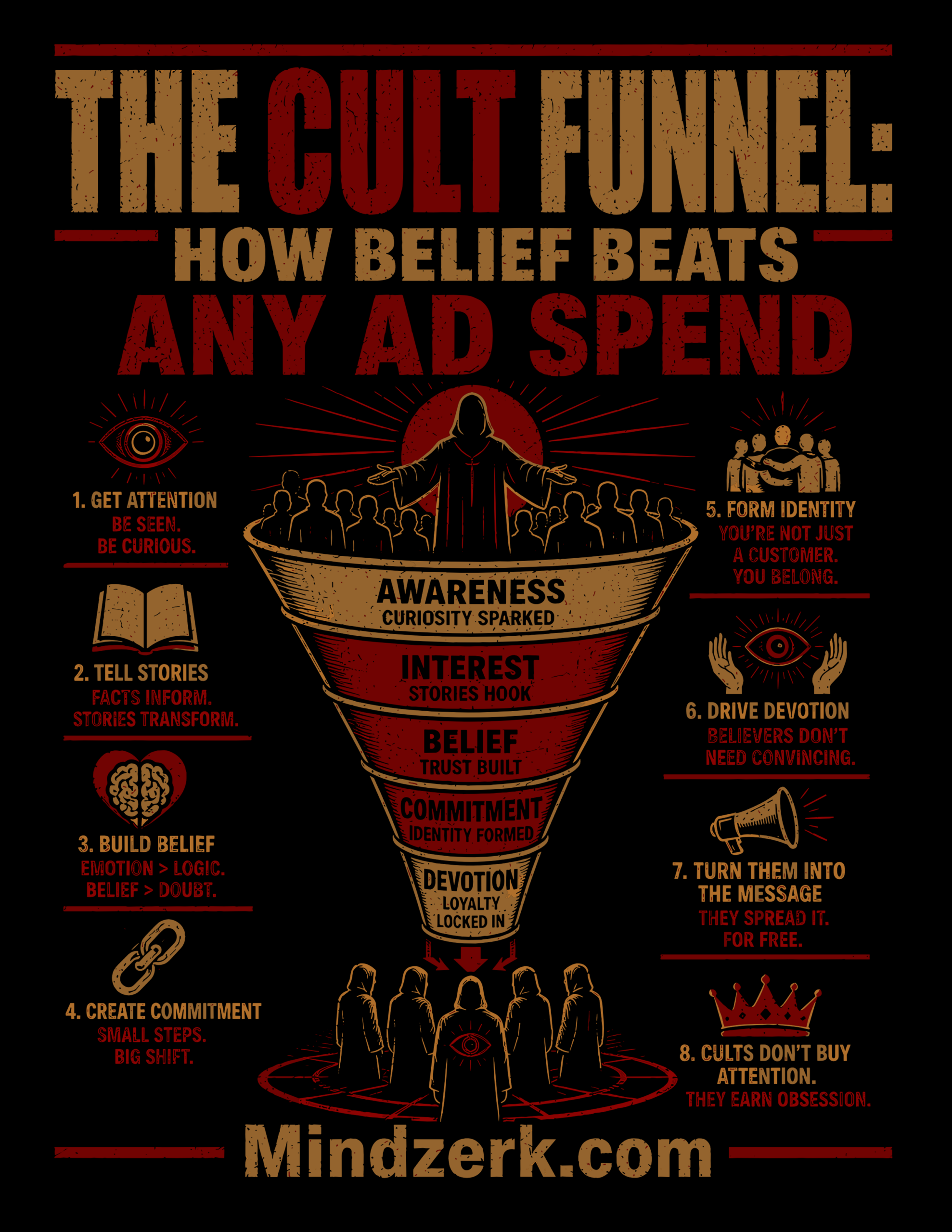
Every cult, religion, and viral movement follows the same psychological progression. Marketers just renamed the steps to sound less sinister.
Here’s the real breakdown:
- Attention → Awakening
The hook doesn’t sell — it interrupts reality.
A phrase, a visual, or a question that cracks the mental shell.
It’s the burning bush moment.
The pattern break that whispers: “Everything you know might be wrong.” - Curiosity → Conversion of Context
Once attention’s hijacked, context must shift.
You don’t teach — you reframe.
The audience realizes the rules they’ve been following don’t work.
You become the new interpreter of reality. - Desire → Doctrine
Your product isn’t the hero — your philosophy is.
Teach the new law of the land. The core beliefs. The ten commandments of your offer.
People need meaning, not discounts. - Purchase → Pilgrimage
The first transaction isn’t payment; it’s initiation.
Buyers step through the veil. They’ve chosen a side.
Treat it like a rite of passage — not a receipt. - Retention → Reinforcement
Reinforce belief with proof loops.
Community wins. Testimonials. Shared success stories.
Each one cements the myth that this works. - Advocacy → Apostleship
Believers become recruiters.
Not because you paid them — because it validates their faith.
Sharing your message becomes part of their identity.
Congratulations. You’ve built the Cult Funnel. You no longer have “customers.” You have disciples.
The Core Equation: Meaning > Mechanism
Humans don’t follow logic — they follow meaning. You can spend millions testing ad variations, but if your audience doesn’t feel like they’re part of something bigger, they’ll vanish the second a cheaper copycat appears.
Every great cult — religious, political, or commercial — exploits this:
- Apple sold rebellion, not hardware.
- CrossFit sold belonging, not burpees.
- Tesla sold purpose, not vehicles.
- Bitcoin sold liberation, not math.
Each turned belief into the brand.
Mechanisms (the “how”) change. Meaning (the “why”) endures.
The Hidden Lever: Identity Disruption
Cult psychology 101: break identity, rebuild belonging.
Before anyone joins your movement, they must realize their current self-image is outdated. That’s why every strong message starts with controlled dissonance — make the audience doubt the version of themselves they’ve been protecting.
“If your system worked, you’d already have what you want.”
“The rules were written to keep you average.”
“Everything you were taught about success was designed to control you.”
That’s not negativity — it’s liberation theater. You’re offering a way out.
Once that doubt lands, you become the safe harbor. That’s when transformation becomes irresistible.
Rituals, Symbols, and Language
Cults don’t grow because they’re logical. They grow because they’re ritualistic.
Humans crave ritual. It’s predictable meaning in a chaotic world. Your funnel should give them structure:
- Symbols: Logos, mascots, slogans — shorthand for belief.
- Language: Invent insider terms. Rename common ideas. “Followers” become “initiates.” “Customers” become “operators.”
- Rituals: Weekly calls, challenges, drops, newsletters, private memes — repetition builds rhythm, rhythm builds religion.
The more you repeat a belief, the more it becomes true in the brain. It’s not propaganda — it’s pattern reinforcement.
The top marketers don’t just “build brands.” They build mythology.
Community as Control System
A true Cult Funnel doesn’t rely on persuasion. It relies on social gravity.
When you create community:
- People police themselves.
- Doubt gets outnumbered.
- New members seek validation through action.
Belief multiplies faster in groups than in isolation. That’s why great movements create micro-tribes: Slack groups, Discord servers, private forums, gated circles.
The community doesn’t just hold attention — it weaponizes it.
Your job isn’t to talk louder. It’s to give believers a place to talk to each other.
That’s when marketing becomes exponential.
Dogma as Defense
When competitors copy your tactics, your doctrine protects you.
Anyone can clone a funnel. No one can clone a faith system.
Your “dogma” — your framework of non-negotiables — keeps the imitators out. Even if they mimic your visuals, your language, or your offers, they can’t fake conviction.
Doctrine is your intellectual moat. When your audience can quote you like scripture, you’ve won.
The Sacrifice Principle
Every cult asks for sacrifice. That’s not exploitation — it’s commitment.
The more someone gives up to join, the deeper their belief runs. That might be time, ego, or comfort. The sacrifice makes belonging valuable.
In marketing terms, it’s earned access. Freebies don’t build loyalty. Challenges, tasks, and buy-ins do.
A person who bleeds for the brand becomes your loudest megaphone. They’re not customers anymore. They’re converts.
The Fear of Excommunication
Cults maintain strength by implying: leave, and you lose identity.
In marketing, this translates to “social stickiness.” The more community, recognition, and emotional investment you give members, the harder it is for them to walk away.
People don’t abandon groups that make them feel seen. They abandon ones that make them feel invisible.
You don’t need to manipulate anyone — just build systems that reward belonging. The result looks like loyalty, but it’s actually self-preservation.
Why Ads Fail Without Faith
Ads talk to logic. Faith talks to identity.
You can’t outbid a belief system with a 20% discount. That’s why so many startups burn through millions and still lose to cult-like competitors.
A Cult Funnel creates gravity. Once someone’s emotionally invested, logic bends around that center of belief. Even if the product’s imperfect, the mission redeems it.
You can’t A/B test conviction. You can only architect environments where it thrives.
How to Build Your Own Cult Funnel (Without Becoming Evil)
Let’s be clear: this isn’t about manipulation.
It’s about meaning. Every brand either accidentally forms a cult or intentionally forms community. One is chaotic; the other is conscious.
Here’s how to do it ethically:
- Mission over margin: Profit follows belief, not the reverse.
- Transparency: Never promise transcendence through a checkout link. Sell real value, wrapped in real philosophy.
- Empower, don’t imprison: Make your customers smarter, not dependent.
- Let members outgrow you: A healthy movement produces free thinkers.
- Audit your myth: Revisit your doctrine regularly. Remove the manipulative parts, keep the magnetic ones.
Ethical cults exist. They’re called communities with purpose.
Case Study: The Hidden Cults of the Internet
Let’s decode a few examples in the wild:
- Notion: A productivity tool that turned into a design-culture religion. Their community shares templates like sacred scrolls.
- Harley-Davidson: Sold identity for decades. Their riders tattoo the logo on their bodies — that’s brand faith, not brand loyalty.
- Y Combinator: Startup accelerator that sells belonging to an elite priesthood of founders. The “YC alumni” badge is modern sainthood.
- Reddit Communities: Each subreddit is a micro-cult. Beliefs, slang, rituals, and heresies included.
These aren’t coincidences. They’re engineered ecosystems of meaning.
The Antidote to Indifference
Belief is the only real scarcity left. Attention is cheap. Data is endless. But conviction — that’s rare.
That’s why the Cult Funnel outlasts paid traffic. It creates believers, not browsers. It transforms casual consumers into co-authors of the story.
Every time they wear your logo, quote your line, or defend your idea, you win free perpetual advertising — powered by devotion.
When people start saying “we” instead of “they,”
you’ve crossed the threshold from commerce to culture.
Final Transmission
The biggest secret in marketing isn’t reach. It’s resonance. You can buy clicks. You can’t buy conviction.
Belief beats budget. Every. Single. Time.
The future of marketing belongs to those who dare to build meaning first, money second. The cults of tomorrow won’t wear robes. They’ll wear merch. They’ll tweet scripture disguised as slogans. They’ll build small empires out of shared madness and mutual conviction.
So if you’re going to build something — Build belief. Everything else is just math.