
Every few weeks, a new AI tool explodes online.
People rush toward it like it’s the final answer:
- The ultimate copywriter
- The perfect image generator
- The automation that changes everything
- The workflow that replaces work itself
Then six months later?
Another tool appears.
Another model launches.
Another “game changer” takes over the feed.
Meanwhile, the people quietly winning with AI usually are not the people chasing every shiny platform.
They are the people with:
- Strong workflows
- Clear systems
- Repeatable processes
- Reliable standards
- Organized thinking
Because the real asset was never the tool.
The real asset is the process behind the tool.
Tools Change. Processes Compound.
AI models improve constantly.
Interfaces change.
Pricing changes.
Features change.
Platforms disappear.
But a strong process survives all of it.
If your workflow is solid:
- You can swap tools easily
- Adapt quickly
- Scale output
- Train others
- Maintain quality
Without a process, every new tool resets you back to zero.
That’s why some people stay stuck endlessly experimenting while others quietly build entire businesses.
The difference is not intelligence.
It’s systems.
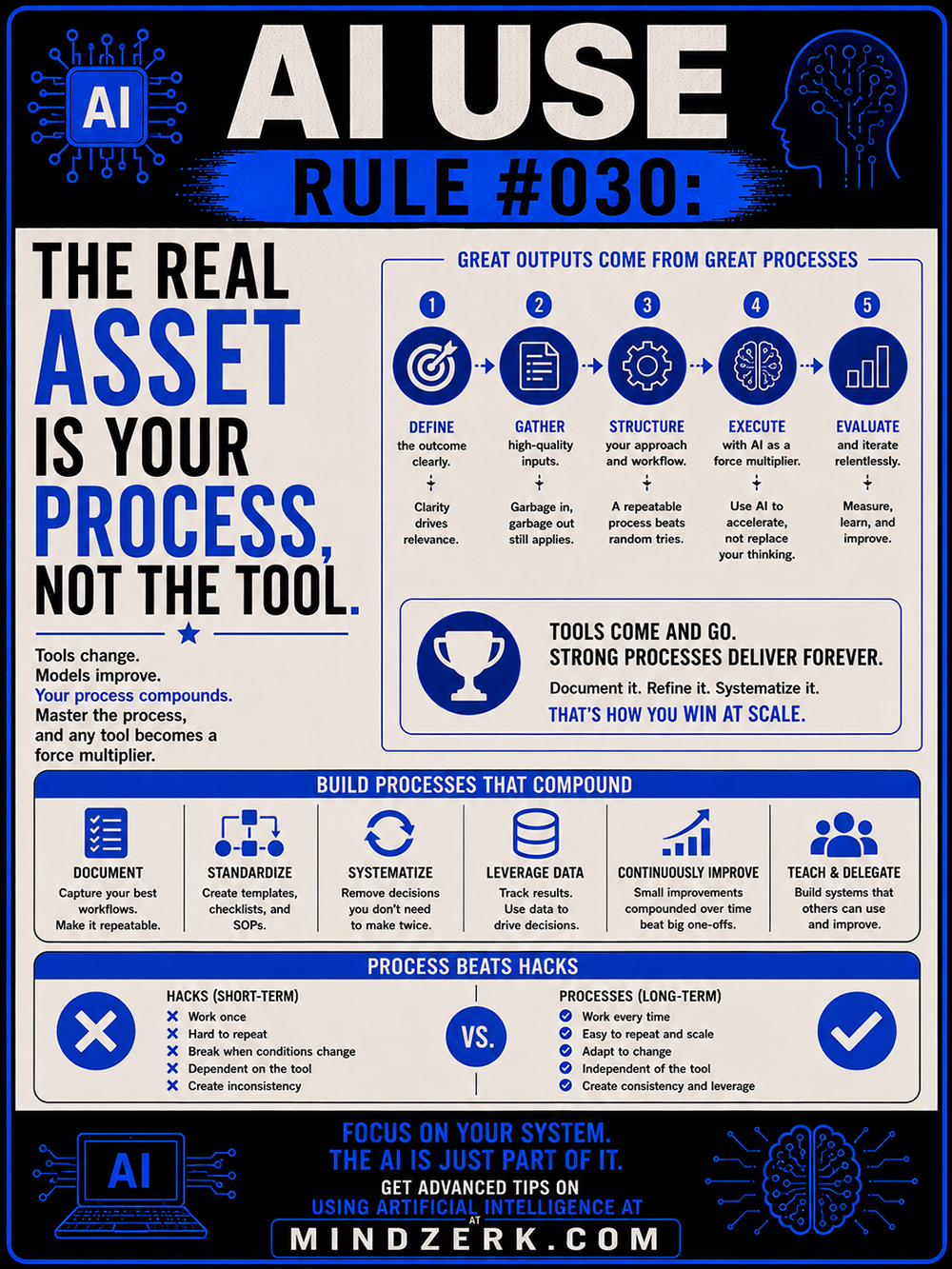
Great Outputs Come From Great Processes
Most bad AI output is not caused by bad AI.
It’s caused by bad workflows.
People:
- Start without a goal
- Give vague prompts
- Skip structure
- Ignore iteration
- Never document what works
Then blame the tool.
But AI amplifies systems.
Good process in?
Better results out.
Garbage process in?
Garbage results out.
Step 1: Define The Outcome Clearly
Before touching AI:
know exactly what success looks like.
Ask:
- What am I creating?
- Who is it for?
- What result should it achieve?
- What tone should it have?
- What constraints matter?
Clarity drives relevance.
AI performs far better when the destination is obvious.
Step 2: Gather High-Quality Inputs
Strong processes rely on strong raw material.
That includes:
- Better prompts
- Better references
- Better examples
- Better context
- Better source material
AI can accelerate thinking.
It cannot magically create clarity from chaos.
If your inputs are weak:
your outputs will usually be weak too.
Step 3: Structure The Workflow
Most people work randomly.
Professionals build repeatable systems.
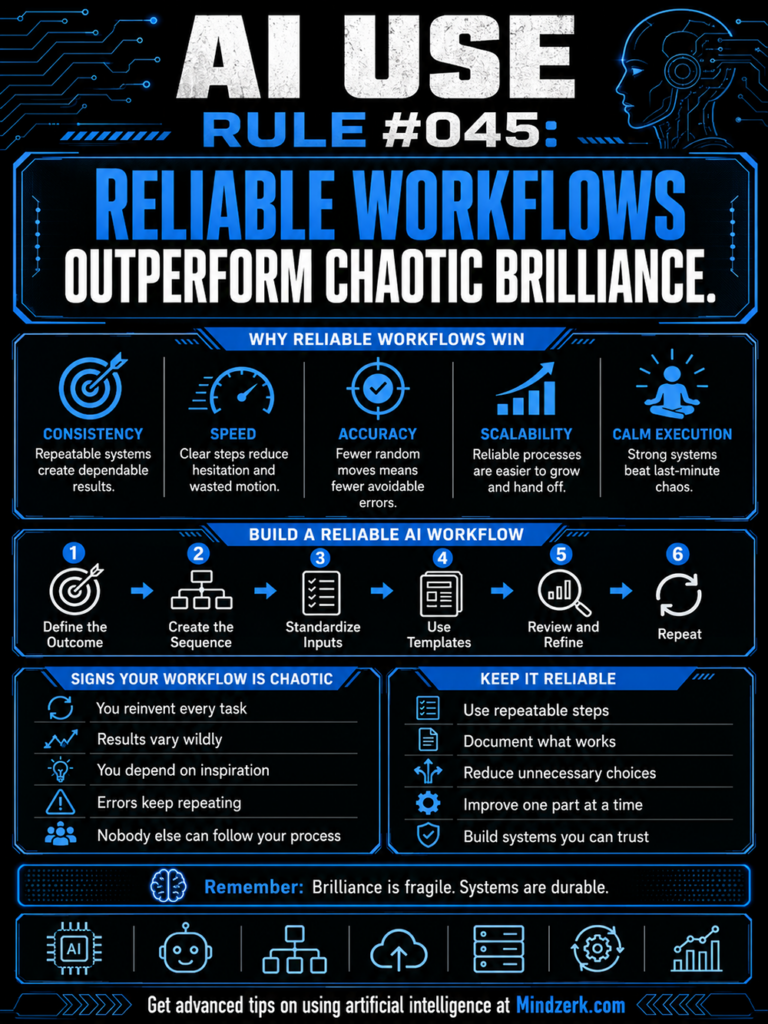
A strong AI workflow might include:
- Research
- Outline
- Draft
- Refine
- Fact-check
- Edit
- Format
- Publish
Notice:
the workflow matters more than the individual tool used during each step.
The tool is replaceable.
The system is valuable.
Step 4: Use AI As A Force Multiplier
AI works best when it accelerates human direction.
Not when it replaces thinking.
Use AI to:
- Speed up production
- Explore ideas
- Organize information
- Generate options
- Reduce repetitive work
But maintain:
- Judgment
- Standards
- Taste
- Strategy
- Final decisions
The operator still matters.
Step 5: Evaluate And Improve Relentlessly
Most workflows fail because people never refine them.
Winning systems evolve.
Track:
- What saves time
- What creates quality
- What consistently works
- Where mistakes happen
- What scales cleanly
Then improve incrementally.
Small workflow improvements compound dramatically over time.
Why Processes Beat Hacks
People love hacks because hacks feel exciting.
But hacks are fragile.
Processes create:
- Consistency
- Reliability
- Scale
- Delegation
- Long-term leverage
A hack works once.
A process works repeatedly.
That distinction matters enormously.
Hacks Depend On Conditions
Short-term hacks usually:
- Break when platforms change
- Depend on one tool
- Require constant reinvention
- Create inconsistency
- Fail under scale
Processes survive change because they are adaptable.
That’s why professionals focus on systems while amateurs chase shortcuts.
Document What Works
One of the most overlooked advantages in AI:
documentation.
Most people discover useful workflows…
then forget them.
Document:
- Prompts
- Templates
- Checklists
- Formats
- Sequences
- Decision trees
- Refinement processes
Once documented:
your process becomes reusable.
That is where real leverage begins.
Standardization Creates Speed
When every project starts from scratch:
you waste enormous mental energy.
Strong systems standardize:
- Inputs
- Naming
- Formatting
- Prompt structures
- Output expectations
- Review processes
This reduces decision fatigue.
And fewer unnecessary decisions means:
more execution.
Systemization Removes Bottlenecks
A process should reduce friction.
If your workflow requires:
- Reinventing prompts constantly
- Hunting for files endlessly
- Guessing formatting every time
- Repeating avoidable tasks
…your system is weak.
Good systems remove repetitive thinking.
That frees attention for:
- Creativity
- Judgment
- Strategy
- Improvement
Data Creates Better Decisions
Strong workflows generate feedback loops.
Track:
- Which prompts convert best
- Which formats perform well
- Which systems save time
- Which outputs actually create results
Without measurement:
you’re guessing.
With measurement:
you improve intelligently.
Teachability Is A Hidden Superpower
A process becomes truly valuable when another person can follow it.
That means:
- Clear documentation
- Repeatable steps
- Defined standards
- Reliable structure
This matters because scalable businesses require delegation.
You cannot scale chaos.
You can scale systems.
The Biggest Mistake AI Users Make
Most people obsess over:
- Which model is best
- Which tool is newest
- Which app has the coolest feature
Meanwhile they ignore:
- Workflow design
- Process quality
- System consistency
- Operational clarity
That’s backwards.
Because over time:
Process beats tooling.
Every single time.
Why This Matters Long-Term
The AI landscape will keep changing.
Models will improve.
Interfaces will evolve.
Platforms will rise and fall.
But if you build:
- Clear systems
- Repeatable workflows
- Organized operations
- Reliable standards
…you stay adaptable no matter what changes.
That adaptability becomes a competitive advantage.
Build Processes That Compound
The strongest AI operators:
- Document everything
- Improve continuously
- Standardize intelligently
- Remove friction
- Measure outcomes
- Refine relentlessly
Over time:
their workflows become assets.
And those assets create:
- Speed
- Reliability
- Scalability
- Freedom
- Leverage
Final Thought
AI is not the business.
The workflow is.
The tool is not the advantage.
The system is.
Because tools come and go.
But strong processes:
- survive change
- improve over time
- scale across platforms
- create consistent results
That’s the real leverage.
Not the app.
Not the model.
Not the hype.
The process.
Focus on your system.
The AI is just part of it.