
A lot of people are drowning in AI tools.
Every week there’s:
- A new chatbot
- A new image generator
- A new automation app
- A new “AI agent”
- A new productivity platform
- A new workflow trend
People collect tools the same way some people collect browser tabs.
And most of the time?
They become less productive, not more.
Because:
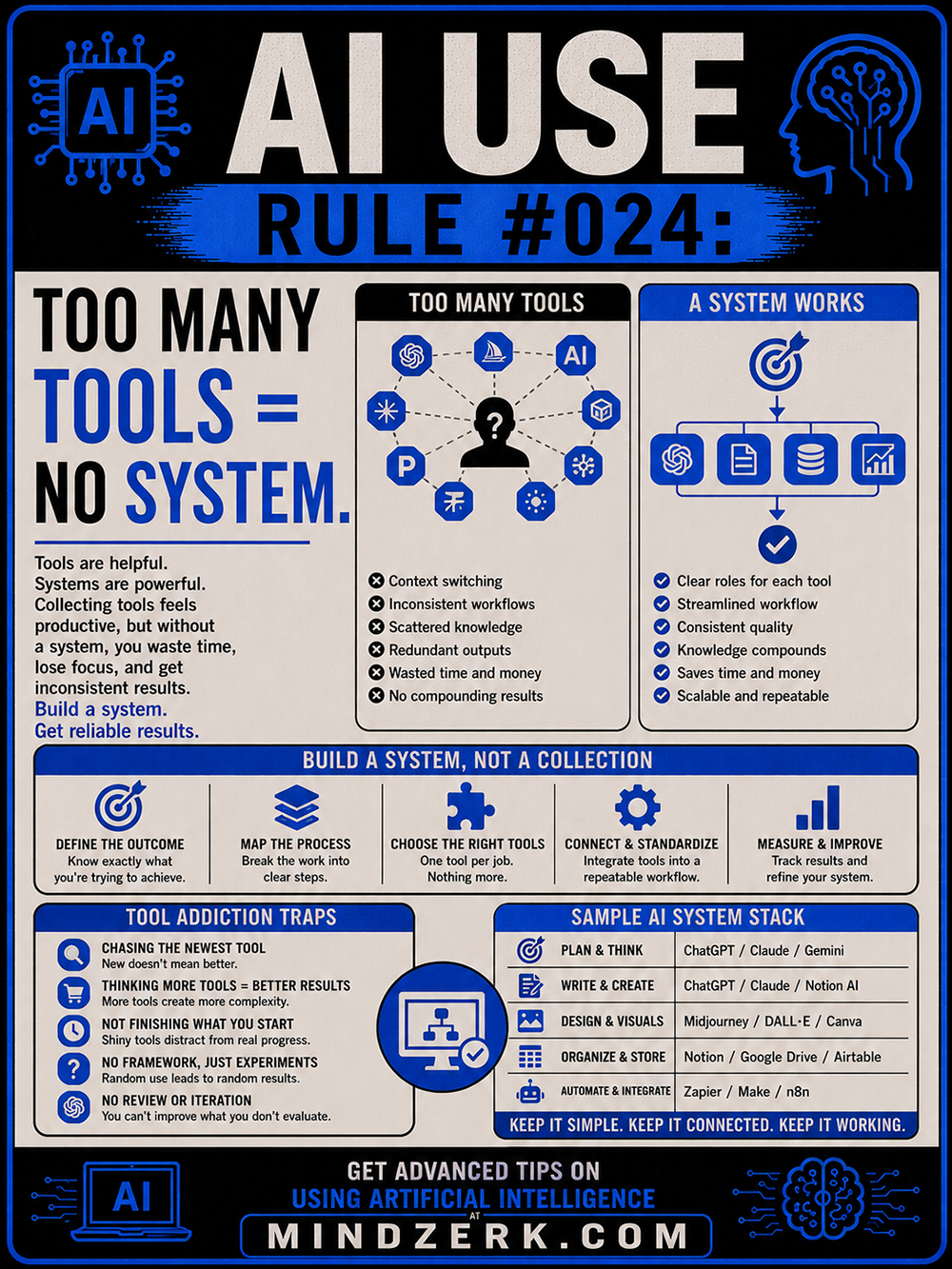
Tools are helpful.
Systems are powerful.
Without a system, tools become noise.
The Tool Addiction Problem
A lot of creators and entrepreneurs fall into the same trap:
They confuse experimentation with progress.
They spend more time:
- Researching tools
- Watching tutorials
- Switching platforms
- Testing features
- Rebuilding workflows
…than actually producing results.
It feels productive because there’s movement.
But movement is not the same as momentum.
Too Many Tools Create Friction
Every additional tool introduces:
- More decisions
- More context switching
- More setup
- More maintenance
- More learning curves
- More possible failures
Eventually your workflow becomes fragmented.
Information ends up scattered across:
- Apps
- Notes
- Drives
- Chats
- Dashboards
- Automation platforms
Now instead of building, you’re managing complexity.
Context Switching Destroys Focus
One of the biggest hidden costs is mental fragmentation.
You:
- Start planning in one app
- Generate ideas in another
- Store prompts somewhere else
- Design in a different platform
- Automate through another service
Then spend half your day remembering where everything lives.
Your brain becomes the integration layer.
That’s inefficient.
Systems Compound. Tools Don’t.
A tool by itself usually does not create leverage.
A repeatable system does.
A strong AI system:
- Produces consistent results
- Saves time repeatedly
- Improves over time
- Reduces mental load
- Scales output
- Makes delegation easier
The goal is not owning more tools.
The goal is reducing friction while increasing output.
Most People Need Fewer Tools
Not more.
A surprising number of productive creators operate with a very small stack.
Because simplicity compounds faster than chaos.
You do not need:
- Seven writing apps
- Four AI chatbots
- Twelve automation layers
- Endless prompt libraries
- Fifty disconnected systems
You need:
- Clear outcomes
- Defined workflows
- Reliable tools
- Consistent execution
That’s it.
Build a System, Not a Collection
A system starts with outcomes.
Ask:
- What am I actually trying to accomplish?
- What output matters?
- What process repeats regularly?
Then build around that.
Step 1: Define the Outcome
Before choosing tools, define the result.
Examples:
- Publish content faster
- Build a newsletter
- Create product visuals
- Organize research
- Automate repetitive tasks
- Manage customer communication
The outcome determines the workflow.
The workflow determines the tools.
Not the other way around.
Step 2: Map the Process
Break your work into steps.
Example:
- Research
- Outline
- Draft
- Edit
- Design
- Publish
- Repurpose
- Archive
Now you can assign tools intentionally instead of randomly.
Step 3: Choose One Tool Per Job
This is where most people fail.
They stack overlapping tools endlessly.
Instead:
- One primary writing tool
- One primary storage system
- One primary image workflow
- One primary automation layer
Redundancy is useful for backups.
Not for daily chaos.
Step 4: Standardize Everything
The more repeatable your process becomes, the faster you move.
Standardize:
- Folder structures
- Naming conventions
- Prompt templates
- Publishing steps
- Automation flows
- Asset storage
Systems reduce decision fatigue.
Step 5: Measure and Improve
A real system gets refined.
Ask regularly:
- What wastes time?
- What breaks often?
- What gets ignored?
- What actually produces results?
Cut what doesn’t help.
Improve what does.
Common Tool Addiction Traps
Chasing the Newest Tool
New does not automatically mean better.
Most “game-changing” tools are abandoned within months.
Stability matters.
Confusing Complexity With Power
A complicated setup often signals poor design.
Simple systems are easier to:
- Maintain
- Scale
- Teach
- Troubleshoot
- Repeat
Endless Experimentation
Experimentation without structure creates randomness.
If every week your workflow changes completely, your progress resets constantly.
Not Finishing Anything
Tool hopping often becomes procrastination disguised as optimization.
You don’t need a perfect stack.
You need completed work.
A Simple AI System Example
You can build a highly effective workflow with just a few connected tools.
Example:
Planning & Thinking
- ChatGPT or Claude
Writing & Organization
- Notion or Google Docs
Visuals
- Canva or Midjourney
Storage
- Google Drive or Dropbox
Automation
- Zapier, Make, or simple manual checklists
That’s enough to run serious operations if the workflow is clear.
Reliability Beats Novelty
The best systems are boring.
They:
- Work consistently
- Stay organized
- Reduce stress
- Produce repeatable results
A flashy stack that constantly changes creates instability.
Reliability creates leverage.
AI Should Reduce Complexity
Not increase it.
If your AI workflow creates:
- More confusion
- More scattered information
- More unfinished projects
- More stress
- More maintenance
…then the system is failing.
Technology should simplify execution.
Not bury you in options.
The Real Advantage
The people who win long-term with AI usually are not:
- The earliest adopters
- The people using the most tools
- The people chasing every trend
They are the people who:
- Build repeatable systems
- Refine workflows
- Eliminate friction
- Stay organized
- Compound knowledge over time
Consistency beats chaos.
Every time.
Final Thought
The AI industry profits from convincing you that the next tool will change everything.
Most of the time, it won’t.
Because tools do not replace:
- Clear thinking
- Structured workflows
- Consistent execution
- Focused systems
A messy collection of tools creates fragmented output.
A clean system creates momentum.
So stop chasing endless software.
Build something reliable.
Keep it simple.
Keep it connected.
Keep it working.
Because:
Too many tools create noise.
Strong systems create leverage.