
Many people focus on the exciting parts of off-grid living.
Solar panels.
Battery banks.
Generators.
Fancy equipment.
But the biggest failures rarely happen where people expect.
A perfectly functioning solar system won’t save you if your water source runs dry.
A full water tank won’t help if you can’t stay warm.
A great heating system won’t matter if waste management becomes a daily problem.
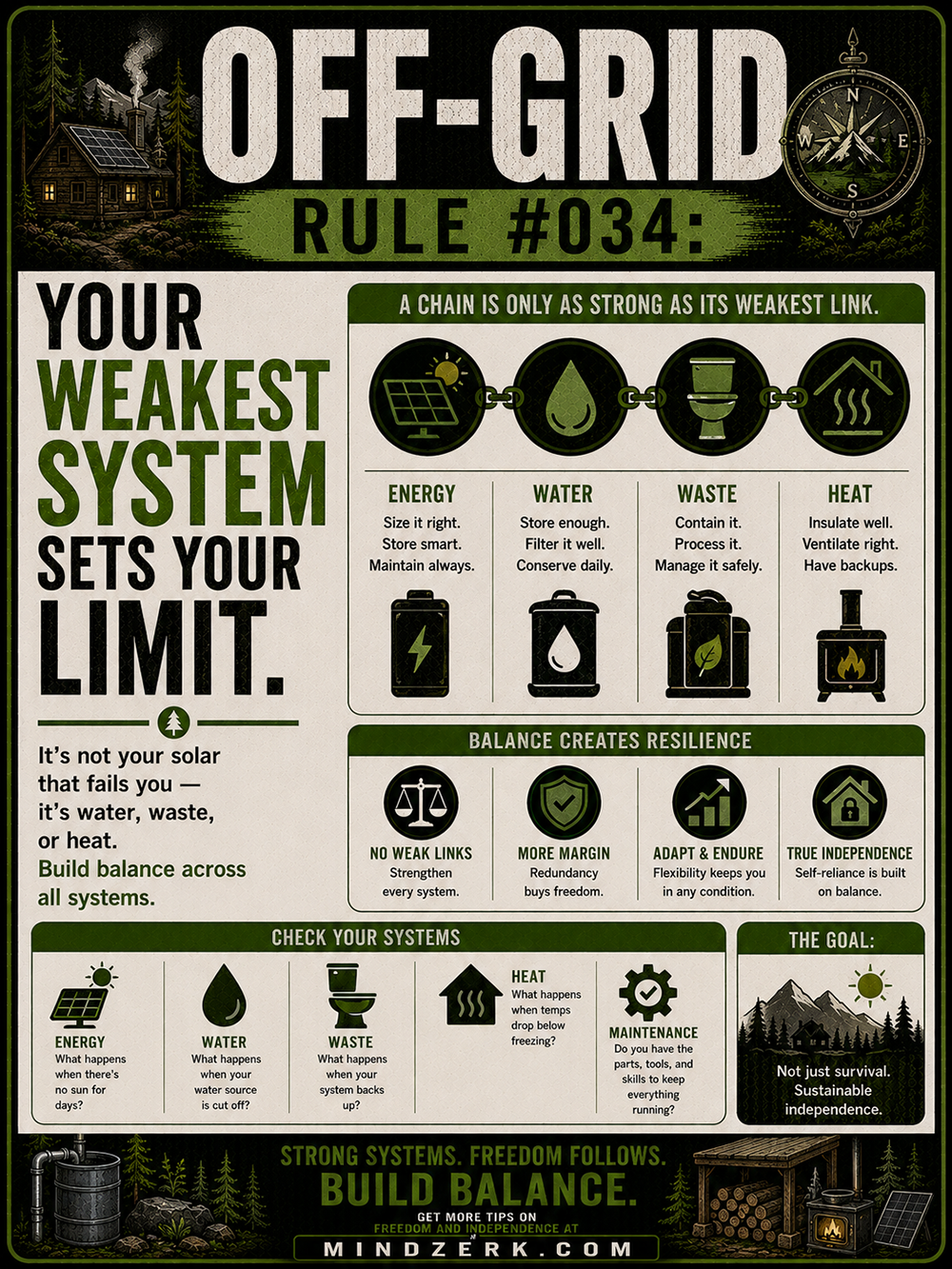
Off-Grid Rule #034: Your Weakest System Sets Your Limit.
Real independence is not built by maximizing one system.
It’s built by balancing all of them.
Off-Grid Living Is a Chain
Think of your homestead as a chain.
Every major system is a link:
- Energy
- Water
- Waste
- Heat
- Shelter
- Maintenance
The chain doesn’t perform based on its strongest link.
It performs based on its weakest one.
You can have the best solar array in the county, but if you only have three days of water storage, your water system becomes the limiting factor.
You can have endless firewood, but if your sanitation system fails, comfort disappears quickly.
Balance matters more than optimization.
The Solar Trap
Many newcomers focus heavily on power.
It’s understandable.
Solar is visible.
Batteries are exciting.
Energy systems are fun to build.
But power is often not the first thing that breaks.
More commonly, people struggle with:
- Water storage
- Water delivery
- Waste handling
- Winter heating
- Food storage
- Equipment maintenance
The result is an expensive solar system supporting a property with weak fundamentals.
Off-grid success comes from strengthening the basics first.
Energy: Build Enough Margin
Power shortages create stress quickly.
Your energy system should be sized for bad days, not perfect days.
Ask yourself:
- What happens during several cloudy days?
- What happens if a battery fails?
- What happens during winter production drops?
- What happens if a charge controller dies?
Redundancy creates resilience.
Margin creates comfort.
Both matter.
Water: The Real Lifeline
Most off-grid problems eventually become water problems.
Water affects:
- Drinking
- Cooking
- Cleaning
- Hygiene
- Gardening
- Animals
Ask yourself:
- How much water do I store?
- How long can I operate if my source fails?
- Do I have backup filtration?
- Can I transport water if necessary?
Many off-grid systems have enough power for weeks but only enough water for days.
That’s a dangerous imbalance.
Waste: The Forgotten System
Nobody dreams about building waste systems.
But everyone depends on them.
Whether you’re using:
- Composting toilets
- Septic systems
- Greywater systems
- Outhouses
Waste must be managed safely and consistently.
Ignoring waste management works for a weekend.
It doesn’t work for long-term living.
Heat: Comfort Becomes Survival
Heat often gets treated as a seasonal issue.
In reality, it’s a resilience issue.
When temperatures drop, small weaknesses become major problems.
Ask yourself:
- What if my primary heat source fails?
- Do I have backup fuel?
- Is my shelter properly insulated?
- Can I heat one room efficiently if necessary?
A backup heat source can mean the difference between inconvenience and emergency.
Maintenance Is a System Too
Many people forget that maintenance itself is part of the off-grid equation.
Every system eventually breaks.
Every system eventually needs repairs.
The question isn’t whether something will fail.
The question is whether you’re prepared when it does.
Do you have:
- Spare parts?
- Basic tools?
- Repair knowledge?
- Backup plans?
Maintenance turns fragile systems into reliable ones.
Balance Creates Freedom
True independence isn’t about having the biggest system.
It’s about having balanced systems.
When all major systems are reasonably strong:
- Problems stay manageable
- Stress decreases
- Flexibility increases
- Recovery becomes easier
You stop living from crisis to crisis.
You start operating with confidence.
A Quick System Audit
Ask yourself these questions:
Energy
What happens if there’s no meaningful sun for a week?
Water
What happens if your primary source becomes unavailable tomorrow?
Waste
What happens if your system backs up or becomes unusable?
Heat
What happens if temperatures drop below freezing tonight?
Maintenance
Do you have the tools, skills, and spare parts needed to keep everything running?
Any answer that makes you uncomfortable points directly at your weakest link.
That’s where improvement should begin.
Sustainable Independence
The goal of off-grid living isn’t survival.
It’s sustainable independence.
Survival means getting through today.
Independence means building systems that continue working next month, next year, and next decade.
That requires balance.
Not just bigger batteries.
Not just more solar.
Not just larger water tanks.
Balanced systems create resilient homesteads.
Resilient homesteads create freedom.
The Bottom Line
Most off-grid failures don’t happen because one system was too small.
They happen because one system was ignored.
Your energy system depends on your water system.
Your water system depends on maintenance.
Your heat system depends on fuel and planning.
Everything connects.
Strong systems create freedom.
Balanced systems create resilience.
And in the end, your off-grid life will always be limited by the weakest system you choose not to strengthen.
Build balance. Freedom follows.