
Most people quit too early because they misunderstand how content actually works.
They post:
- One video
- One article
- One product
- One thread
- One ad
Then nothing happens.
No explosion.
No flood of customers.
No instant breakthrough.
So they assume:
- The niche is dead
- The algorithm is rigged
- They are bad at content
- Their idea failed
But here’s the reality:
Most content gets ignored.
A few pieces break through.
That’s normal.
Success in content is rarely about one perfect piece.
It’s about building a system that survives long enough to produce winners.
Content Is a Volume Game
The internet is noisy.
Millions of pieces of content are uploaded every day:
- Videos
- Tweets
- Blog posts
- Podcasts
- Emails
- Shorts
- Ads
- Graphics
- Memes
Most disappear instantly.
That’s not failure.
That’s filtering.
The market filters constantly until:
- Timing matches
- The hook lands
- The audience connects
- The message resonates
- The platform pushes it
- The right people share it
You cannot predict every winner.
You can only increase your chances by staying in the game.
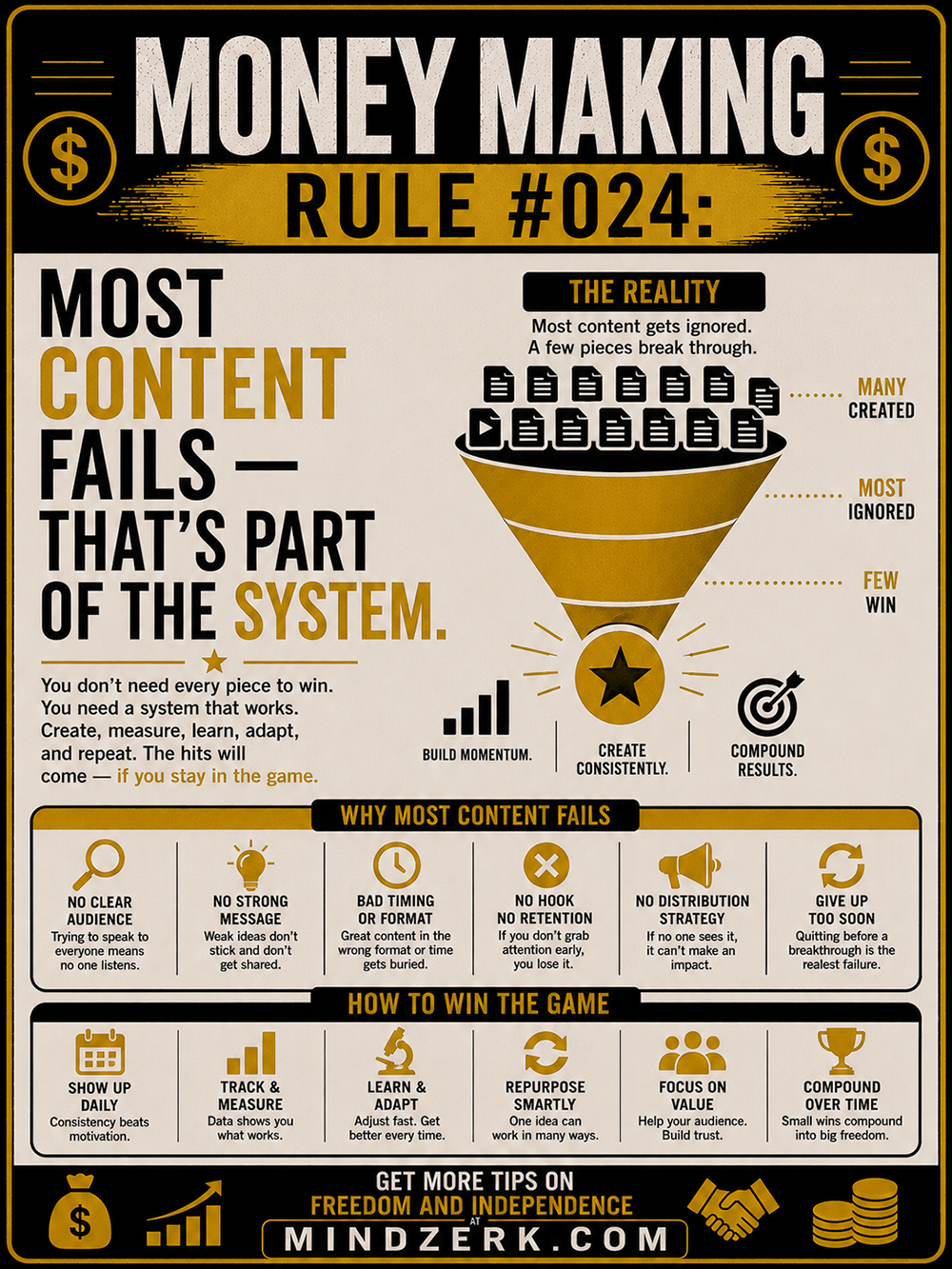
The Funnel Reality
Think of content like a funnel.
At the top:
- Many pieces are created
In the middle:
- Most get ignored
At the bottom:
- A few win big
Those few winners often:
- Drive traffic for months
- Generate leads
- Build authority
- Produce sales
- Open opportunities
- Compound over time
One strong piece can outperform dozens of average ones combined.
But you only discover winners by publishing consistently.
Most Creators Quit Before the Data Arrives
This is where most people lose.
They expect immediate validation.
When it does not happen, they stop creating before the system has enough data to work.
That’s like planting seeds and digging them up every two days because nothing grew yet.
Consistency creates momentum.
Momentum creates visibility.
Visibility creates opportunities.
Why Most Content Fails
Understanding failure removes emotional attachment.
Most content fails for predictable reasons.
No Clear Audience
Trying to speak to everyone usually means connecting with no one.
Specificity matters.
People respond to content that feels:
- Relevant
- Direct
- Personal
- Focused on their problems
Broad messaging disappears into the noise.
Weak Messaging
Weak content often says:
- Nothing memorable
- Nothing emotional
- Nothing actionable
- Nothing surprising
Strong content creates:
- Curiosity
- Emotion
- Clarity
- Contrast
- Tension
- Value
If people forget your content instantly, it dies instantly.
Bad Timing or Format
Sometimes the idea is good.
The format is wrong.
Or the timing is wrong.
A great long-form article posted where short-form dominates may fail.
A short-form post covering a topic that requires depth may fail.
The market rewards matching:
- Message
- Platform
- Timing
- Format
- Audience behavior
No Hook = No Attention
Attention is the gatekeeper.
If you fail to capture attention quickly:
- Nobody reads
- Nobody watches
- Nobody shares
Hooks matter because people are overwhelmed.
You are competing against:
- Endless scrolling
- Notifications
- Entertainment
- Algorithms
- Short attention spans
No hook means no opportunity.
No Distribution Strategy
Many creators assume “post it and they will come.”
That is fantasy.
Content often needs:
- Repurposing
- Reposting
- Cross-platform distribution
- Email promotion
- SEO
- Community sharing
- Networking
- Consistency
Good content with poor distribution often dies unseen.
Giving Up Too Soon
This is the biggest killer.
People quit before:
- Learning patterns
- Improving hooks
- Understanding audiences
- Building momentum
- Developing skills
- Creating compounding effects
The people who often “suddenly succeed” usually spent years stacking invisible reps.
The Real Goal Is Not Viral Success
The goal is not one lucky hit.
The goal is:
- A repeatable system
- Better pattern recognition
- Consistent creation
- Continuous improvement
- Sustainable momentum
A system survives bad posts.
A system learns from weak performance.
A system compounds over time.
How To Win the Content Game
Show Up Daily
Consistency beats emotional motivation.
You do not need perfect energy.
You need repetition.
Momentum rewards creators who continue publishing while others disappear.
Track and Measure
Most people guess.
Winning creators study patterns.
Track:
- Click-through rates
- Watch time
- Shares
- Saves
- Comments
- Email signups
- Sales
- Engagement patterns
Data reveals what the audience actually values.
Learn and Adapt Fast
Do not become emotionally attached to formats or ideas.
Weak creators defend failing content.
Strong creators adjust quickly.
Adaptation beats stubbornness.
Repurpose Smartly
One idea can become:
- A thread
- A video
- A short
- A blog post
- An infographic
- An email
- A podcast topic
- A downloadable PDF
You do not need endless new ideas.
You need better leverage from existing ones.
Focus on Value
The creators who survive long term usually help people solve something.
Value builds:
- Trust
- Repeat attention
- Word of mouth
- Loyalty
- Authority
Vanity metrics without value rarely create sustainable businesses.
Compounding Is the Secret
Small wins compound.
Every piece teaches:
- Better hooks
- Better storytelling
- Better formatting
- Better audience understanding
- Better positioning
Over time:
- Your systems improve
- Your speed improves
- Your instincts improve
- Your distribution improves
- Your library grows
The compound effect becomes massive.
Content Creation Is Statistical
This is important to understand emotionally.
You are not judged by one post.
You are judged by:
- Long-term consistency
- Overall body of work
- Ability to improve
- Ability to stay in motion
One failed post means nothing.
Ten failed posts mean nothing.
Even fifty may mean nothing.
Because the next one could change everything.
The Winners Usually Create More
People often think successful creators win because they are naturally gifted.
Often they win because:
- They tested more
- Published more
- Learned faster
- Stayed longer
- Improved continuously
Volume creates opportunities for breakthroughs.
Perfectionism kills momentum.
Stop Treating Failure Like a Final Verdict
A failed post is not a failed business.
A weak video is not a failed creator.
A low-performing article is not proof you should quit.
It is feedback.
Nothing more.
Every creator you admire has buried failures behind the scenes.
You simply never saw them.
Final Thought
Most content fails.
That is not a sign the system is broken.
That is the system.
The internet rewards:
- Consistency
- Adaptation
- Repetition
- Volume
- Persistence
- Pattern recognition
You do not need every piece to succeed.
You need enough repetitions to discover what works.
So:
- Create more
- Test more
- Learn faster
- Repurpose intelligently
- Track results
- Stay consistent
- Keep publishing
Because the people who win are usually not the people who made one perfect post.
They are the people who stayed in the game long enough for the winners to appear.