
Most emergencies do not arrive politely.
They happen fast.
Power goes out.
Something breaks outside at night.
A storm rolls in.
You smell smoke.
A pipe bursts.
Your vehicle gets stuck.
Someone gets hurt.
You suddenly need to leave the house, check something in the dark, or solve a problem immediately.
That is not the moment to start searching for batteries, digging through drawers, or trying to remember where you left your flashlight.
That is why every off-grid setup should have at least one dedicated:
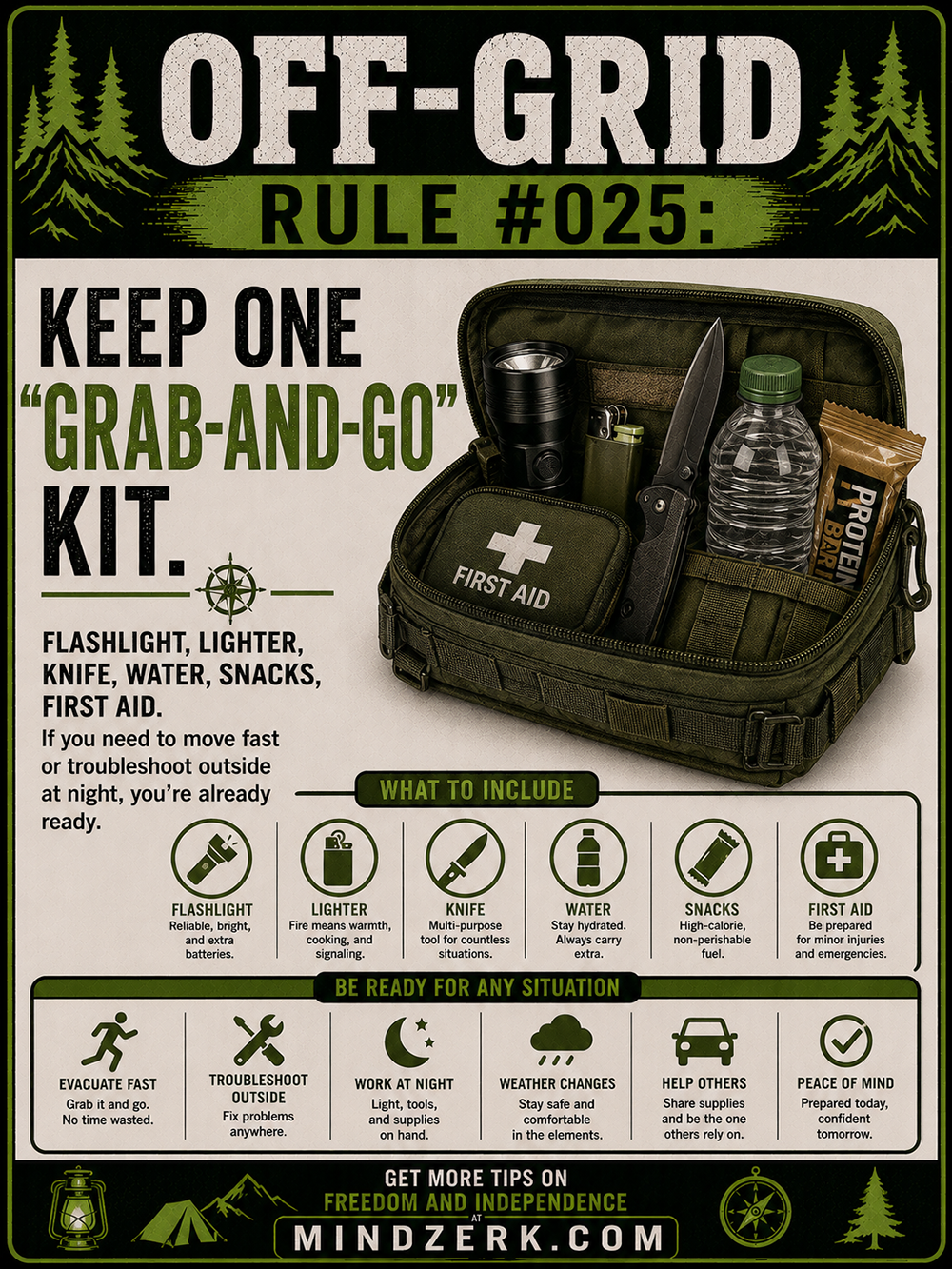
Grab-and-go kit.
A small, ready-to-move bag containing the essentials you can grab instantly when seconds matter.
The Purpose of a Grab-And-Go Kit
The goal is simple:
- Immediate access
- Immediate mobility
- Immediate capability
Your grab-and-go kit is not meant to replace your entire storage system.
It is meant to bridge the gap between:
- Normal life
…and… - Sudden action
Think of it as your:
- First-response kit
- Night troubleshooting kit
- Emergency mobility kit
- Rapid access supply bag
The best kit is:
- Compact
- Organized
- Durable
- Always ready
Why Speed Matters
Most people focus only on quantity.
They stockpile supplies but forget accessibility.
A giant pile of gear buried in storage does not help much if:
- The power is out
- You are half asleep
- The weather is bad
- You need to move quickly
- You only have seconds
Preparedness is not just owning equipment.
Preparedness is:
Being able to reach and use it immediately.
What Every Grab-And-Go Kit Should Include
The exact setup depends on your environment and goals, but a solid basic kit should cover:
- Light
- Fire
- Water
- Cutting tools
- Food
- Basic medical needs
Simple. Reliable. Fast.
1. Flashlight
A flashlight is one of the most important tools you can own.
Darkness slows everything down.
A good flashlight allows you to:
- Navigate safely
- Inspect problems
- Avoid injuries
- Signal for help
- Work at night
Keep:
- Extra batteries
or - Rechargeable backups
Cheap flashlights fail when you need them most.
Buy dependable ones.
2. Lighter or Fire Starter
Fire provides:
- Warmth
- Cooking
- Light
- Signaling
- Psychological comfort
A lighter takes almost no space but solves massive problems.
Even if you already carry one elsewhere:
Put another in the kit.
Redundancy matters.
3. Knife or Multi-Tool
A knife becomes useful constantly:
- Cutting rope
- Opening packaging
- Preparing food
- Repairs
- Emergency tasks
A sturdy folding knife or compact multi-tool gives enormous utility in a small package.
Do not overcomplicate it.
Reliable beats tactical fantasy gear every time.
4. Water
Dehydration becomes a problem faster than most people realize.
Always keep:
- A water bottle
or - Pouches
or - Compact filtration
Rotate stored water regularly.
Heat destroys stored water quality faster than people expect.
5. Snacks or Emergency Calories
You do not need a survival feast.
You need:
- Fast energy
- Stability
- Convenience
Protein bars, nuts, jerky, trail mix, or calorie-dense emergency snacks work well.
Hunger destroys focus and decision-making.
Even a small amount of food helps.
6. First Aid Supplies
Minor injuries become major problems when ignored.
A compact kit should include basics like:
- Bandages
- Gauze
- Antiseptic
- Pain relievers
- Gloves
- Tape
Customize based on:
- Medical needs
- Environment
- Skill level
Keep It Ready — Not Buried
A grab-and-go kit only works if:
- You know where it is
- You can access it immediately
- It stays stocked
Do not bury it behind storage bins.
Do not hide it under piles of gear.
Place it:
- Near the door
- In your vehicle
- By your work area
- Near your sleeping space
The point is speed.
One Kit Is Better Than None
People often delay preparedness because they imagine building some giant perfect system.
You do not need perfection to improve your situation.
Start simple.
Even a small kit dramatically improves readiness.
A flashlight, lighter, water bottle, knife, and first aid pouch already place you ahead of most people.
Situations Where Grab-And-Go Kits Matter
You will likely use this kit more for small events than dramatic disasters.
Examples:
- Power outages
- Generator troubleshooting
- Nighttime repairs
- Vehicle problems
- Storm response
- Minor injuries
- Sudden evacuations
- Helping neighbors
- Outdoor work
- Camping or travel
Preparedness becomes practical when it solves normal problems too.
Keep One in Your Vehicle Too
Vehicle kits are extremely valuable.
Cars break down.
Roads close.
Weather changes quickly.
A compact vehicle kit can contain:
- Flashlight
- Water
- Jumper pack
- Snacks
- Blanket
- Basic tools
- Poncho
- Medical supplies
A vehicle kit turns inconvenience into manageable problems.
Rotate and Check Regularly
A neglected kit slowly becomes useless.
Check regularly for:
- Dead batteries
- Expired food
- Missing items
- Damaged gear
- Leaking containers
Preparedness requires maintenance.
Even simple systems need attention.
Avoid the “Fantasy Kit” Trap
Many people build oversized kits full of:
- Gadgets
- Tactical junk
- Rarely used tools
- Heavy unnecessary gear
Focus on:
- Practicality
- Reliability
- Simplicity
Your kit should help you move faster, not slower.
Preparedness Creates Calm
One hidden benefit of a grab-and-go kit is psychological.
Prepared people panic less.
When problems happen, you already know:
- Where your essentials are
- What tools you have
- What your next steps are
That calm matters.
Chaos becomes easier to handle when you already prepared for it.
Build Your Kit Around Reality
Think honestly about:
- Your environment
- Your weather
- Your lifestyle
- Your risks
A desert environment needs different gear than a snowy forest.
An urban apartment needs different gear than a rural cabin.
Preparedness works best when it matches reality.
The Off-Grid Mindset
Off-grid living is not about paranoia.
It is about reducing unnecessary dependence.
It is about:
- Capability
- Readiness
- Self-reliance
- Practical systems
A grab-and-go kit is one of the simplest and most useful systems you can build.
Small preparation today prevents major stress tomorrow.
Final Thought
Most emergencies are not cinematic.
They are inconvenient, sudden, messy, and fast.
The people who handle them best are usually the ones who prepared beforehand.
Not perfectly.
Just practically.
A small bag with:
- Light
- Water
- Fire
- Tools
- Food
- First aid
…can solve an enormous number of problems.
So keep one ready.
Not someday.
Now.
Because when something happens:
The best gear in the world means nothing if you cannot reach it in time.