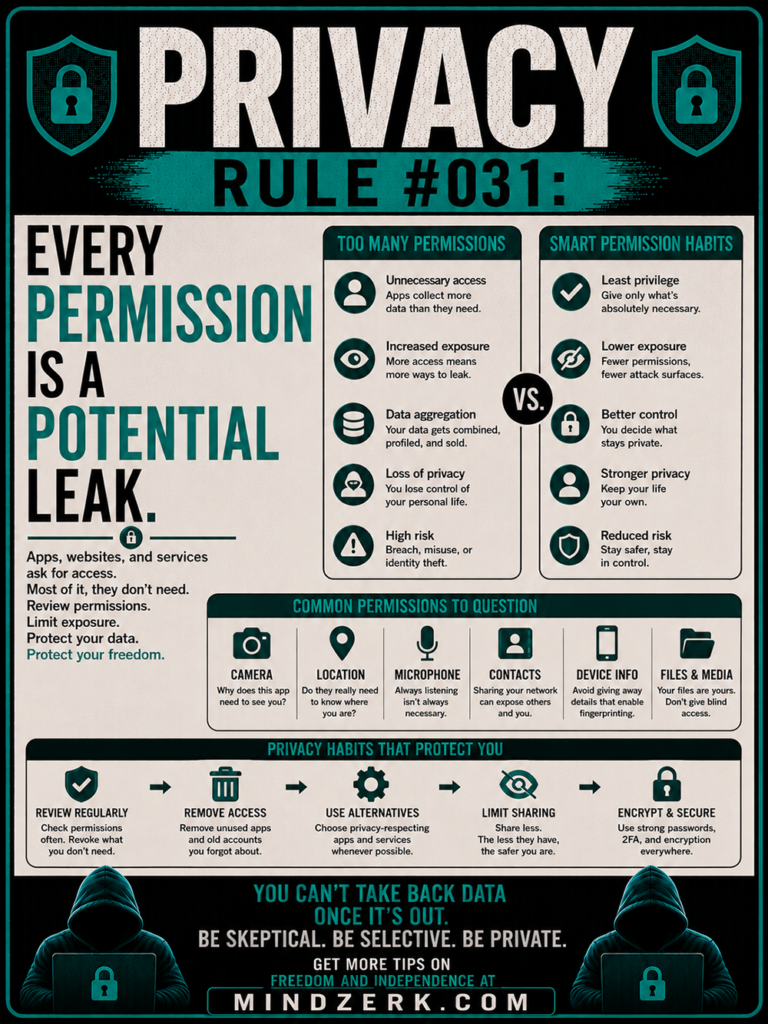


Most people think privacy is about hiding.
It is not.
Privacy is about control.
Control over:
- Your information
- Your systems
- Your vulnerabilities
- Your movements
- Your operations
- Your future options
Every unnecessary detail you share gives away pieces of that control.
That is why:
Oversharing breaks systems.
Information is power.
And every piece of information released into the world becomes something that:
- Can be tracked
- Stored
- Shared
- Misunderstood
- Manipulated
- Exploited
- Combined with other information later
The danger is not always immediate.
That is what makes it dangerous.
Every Shared Detail Creates Exposure
Most people do not realize how small details stack together.
One post may seem harmless.
But over time people reveal:
- Their routines
- Their habits
- Their location
- Their equipment
- Their relationships
- Their schedules
- Their finances
- Their weaknesses
- Their systems
Eventually, outsiders can build a surprisingly complete picture.
This happens constantly online.
Not just from:
- Social media
- Videos
- Photos
- Comments
…but from:
- Metadata
- Background details
- Patterns
- Timing
- Casual conversations
- Public records
- Shared screenshots
Oversharing is rarely one big mistake.
It is usually:
Hundreds of small leaks over time.
Information Becomes a Vulnerability
People often think:
“Who would care about my information?”
That is the wrong question.
The real question is:
“Could this information be useful to the wrong person someday?”
Because information can be used for:
- Social engineering
- Scams
- Manipulation
- Surveillance
- Theft
- Doxxing
- Harassment
- Competitive advantage
- Physical targeting
Details that seem meaningless today can become valuable later.
Especially when combined together.
Systems Become Easier to Attack When Exposed
Every system has weak points.
The more outsiders know:
- What you use
- How you operate
- Where things are
- What platforms you depend on
- What your routines look like
…the easier it becomes to:
- Predict behavior
- Disrupt operations
- Manipulate trust
- Exploit dependencies
- Pressure vulnerabilities
Strong systems rely partly on limited visibility.
What people do not know is much harder to attack.
Oversharing Invites Unwanted Attention
Attention is not always good.
Public visibility attracts:
- Critics
- Competitors
- Scammers
- Opportunists
- Obsessive people
- Manipulators
- Platform scrutiny
The more information you broadcast, the wider your attack surface becomes.
Especially online.
Some people unknowingly advertise:
- Their entire tech stack
- Their income sources
- Their schedules
- Their physical locations
- Their backup systems
- Their business vulnerabilities
All publicly.
Then wonder why problems appear later.
Silence Is a Form of Protection
Not everything needs to be public.
Not every thought needs posting.
Not every system needs explanation.
Not every success needs broadcasting.
Modern culture encourages constant sharing:
- Constant updates
- Constant visibility
- Constant exposure
But privacy often grows stronger through restraint.
Sometimes the smartest move is simply:
Say less.
“Need To Know” Is a Powerful Principle
One of the strongest privacy frameworks is:
Share on a need-to-know basis.
Ask:
- Does this person actually need this information?
- Does sharing this improve my situation?
- Could this detail create risk later?
- Am I sharing for utility or attention?
Most oversharing happens emotionally:
- Excitement
- Ego
- Validation seeking
- Anger
- Fear
- Impulse
Strong privacy requires discipline.
Loose Talk Weakens Security
People talk.
Information spreads.
Even trusted people accidentally:
- Reveal details
- Repeat stories
- Share screenshots
- Mention locations
- Expose systems
This is why operational security often fails socially rather than technically.
One casual conversation can expose:
- Plans
- Infrastructure
- Habits
- Financial information
- Weaknesses
Privacy is not paranoia.
It is understanding how information flows.
The Internet Never Really Forgets
Overshared information can persist for years.
Even deleted content may survive through:
- Archives
- Screenshots
- Cached pages
- Data brokers
- Scrapers
- Platform storage
That means:
- Old posts
- Old comments
- Old usernames
- Old photos
- Old conversations
…can continue creating risk long after you forgot them.
Think long-term before posting short-term emotions.
Competitors Learn From Oversharing Too
This applies to business as well.
Oversharing:
- Systems
- Strategies
- Revenue details
- Supplier information
- Workflows
- Growth methods
…can weaken your competitive advantage.
Not every lesson needs to become public documentation.
Sometimes keeping systems private preserves leverage.
Privacy Protects Freedom
The more exposed you become:
- The easier you are to track
- The easier you are to manipulate
- The easier you are to pressure
- The easier you are to target
Privacy creates:
- Flexibility
- Optionality
- Independence
- Resilience
Freedom often depends on maintaining some level of controlled visibility.
Think Before You Share
Before posting or discussing something, ask:
- Does this create unnecessary exposure?
- Could this reveal patterns?
- Does this weaken operational security?
- Would I regret this later?
- Am I sharing this for a useful reason?
A short pause prevents many problems.
Protect Systems, Not Just Accounts
Privacy is not only about passwords and encryption.
It is also about:
- Behavioral discipline
- Information control
- Pattern management
- Operational awareness
You can have strong passwords while still exposing yourself constantly through oversharing.
Technical security matters.
But behavioral security matters too.
Practical Ways to Reduce Oversharing
1. Share Less by Default
Not everything needs documenting publicly.
Especially:
- Locations
- Routines
- Infrastructure
- Financial details
- Real-time activity
- Sensitive systems
2. Remove Metadata
Photos often contain:
- GPS data
- Device information
- Time data
Strip metadata before uploading sensitive images.
3. Separate Public and Private Identities
Avoid linking everything together unnecessarily.
Compartmentalization reduces exposure.
4. Limit Real-Time Posting
Posting events after they happen is often safer than broadcasting your current location live.
5. Review Old Content
Old posts may expose more than you realize.
Audit periodically.
6. Avoid Bragging About Systems
The more detailed your public systems become, the easier they are to analyze and target.
Privacy Is a Force Multiplier
Strong privacy:
- Reduces attack surface
- Preserves flexibility
- Protects systems
- Protects relationships
- Protects opportunities
- Protects independence
Weak privacy slowly erodes all of those things.
Final Thought
Oversharing feels harmless because the consequences are rarely immediate.
That creates the illusion of safety.
But every unnecessary detail released publicly creates:
- More exposure
- More patterns
- More vulnerability
- More opportunities for exploitation
Strong systems stay strong partly because:
They are not fully exposed.
You do not need to become paranoid.
You simply need discipline.
Share less.
Reveal less.
Protect what matters.
Because:
What others do not know is much harder for them to use against you.