
Most people chase money.
Very few build systems.
That’s why so many people stay trapped in cycles of:
- constant hustling
- unpredictable income
- burnout
- starting over
- chasing the next opportunity
One-off wins feel exciting.
You land a client.
Make a sale.
Have a viral post.
Get a lucky break.
Hit a good month.
Then what?
If everything depends on your constant manual effort, you didn’t build leverage.
You built a treadmill.
Real freedom comes from systems.
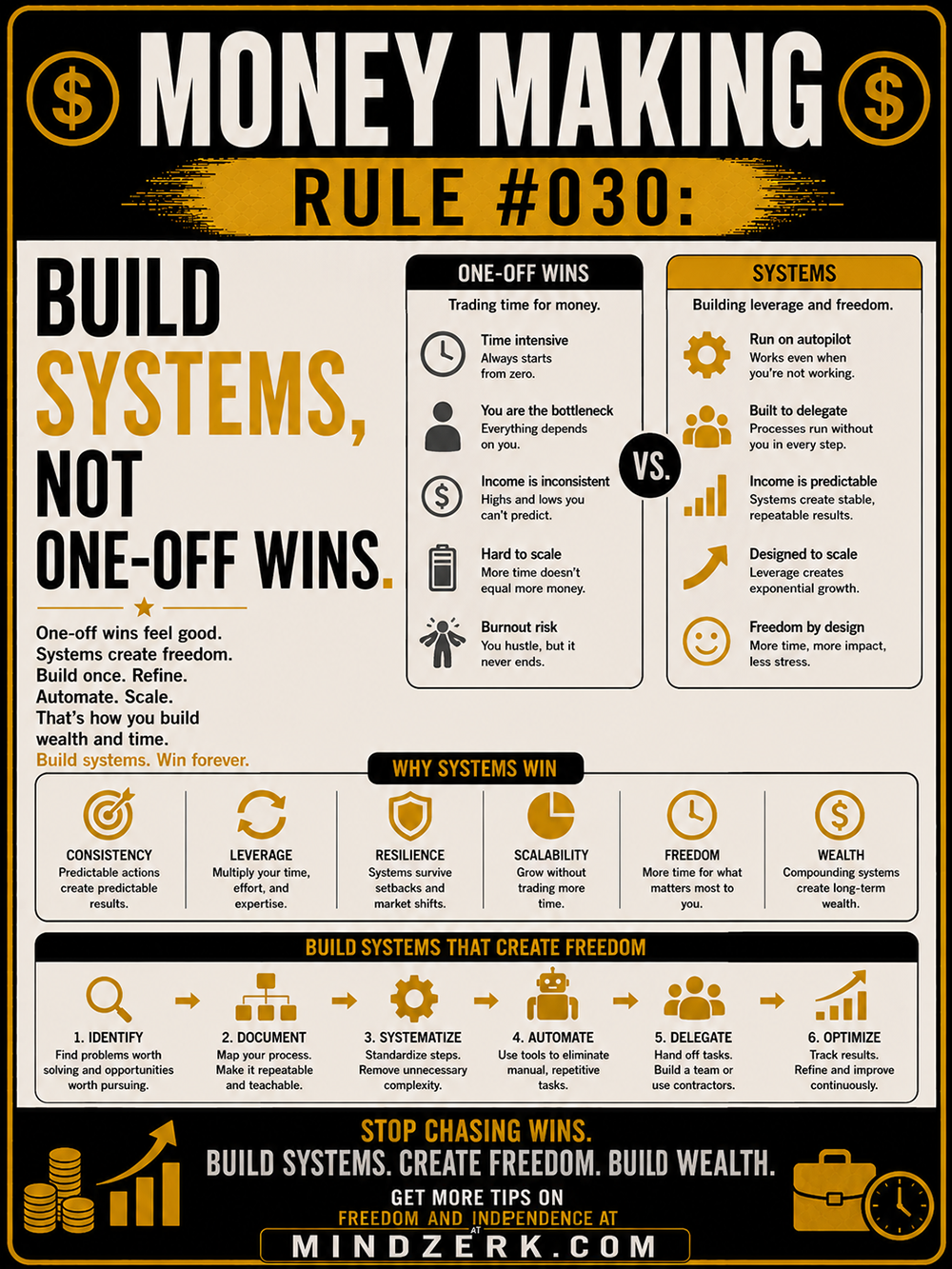
One-Off Wins Trade Time For Money
Most people operate entirely through one-time effort.
They:
- work
- get paid
- stop working
- stop getting paid
That model has limits.
Why?
Because:
- your energy is limited
- your time is limited
- your attention is limited
You become the bottleneck.
Everything depends on you personally pushing every result forward.
That creates:
- exhaustion
- inconsistency
- stress
- unpredictability
And eventually:
burnout.
Systems Create Leverage
Systems work differently.
A system:
- continues operating after setup
- creates repeatable outcomes
- removes unnecessary manual work
- compounds over time
- scales more efficiently
That’s leverage.
Instead of trading hours for dollars, systems multiply effort.
That is how people eventually create:
- freedom
- scalability
- predictable income
- flexibility
- long-term wealth
What A System Actually Is
People overcomplicate the word “system.”
A system is simply:
A repeatable process that reliably creates a result.
That’s it.
Examples:
- an email funnel
- a repeatable content workflow
- a documented sales process
- a product creation pipeline
- an automated follow-up sequence
- a referral process
- a customer onboarding flow
The goal is repeatability.
Not chaos.
Why Systems Win
Systems create advantages that one-off effort never can.
Consistency
Systems reduce randomness.
Instead of hoping for results,
you create conditions that regularly produce them.
Consistency builds stability.
Leverage
Systems multiply effort.
One piece of work can continue producing:
- traffic
- leads
- sales
- opportunities
Long after you created it.
That’s how leverage works.
Resilience
One-off hustles collapse easily.
Systems survive:
- setbacks
- bad days
- distractions
- temporary slowdowns
- market shifts
Because the structure continues operating.
Scalability
You cannot manually scale everything forever.
Eventually:
time runs out.
Systems allow growth without increasing effort proportionally.
That’s the difference between:
- grinding harder
and - scaling intelligently
Freedom
Systems create breathing room.
More time.
Less stress.
Better flexibility.
Not because work disappears.
Because systems reduce unnecessary dependency on constant manual effort.
Most People Stay Addicted To Short-Term Wins
One-off wins feel emotionally rewarding.
You get immediate validation.
But short-term wins often hide long-term weakness.
People constantly chase:
- viral moments
- random sales spikes
- sudden opportunities
- trendy tactics
Meanwhile they never build infrastructure underneath the success.
So every month becomes another survival cycle.
Build Once. Refine Forever.
Strong systems are rarely built perfectly the first time.
The key is:
- start simple
- document what works
- improve gradually
- eliminate friction
- automate repetitive tasks
Systems evolve.
That evolution creates compounding advantages.
Document Everything
Most people waste time reinventing processes repeatedly.
Documentation changes that.
Write down:
- workflows
- checklists
- templates
- procedures
- repeatable sequences
- standards
Once documented:
your process becomes reusable.
And reusable systems create leverage.
Standardization Removes Chaos
Chaos destroys scale.
Systems improve when:
- steps become predictable
- processes become repeatable
- decisions become simplified
Standardization reduces:
- errors
- confusion
- wasted energy
- unnecessary thinking
Simple systems outperform messy brilliance over long periods.
Automation Removes Repetitive Work
Automation should remove low-value repetitive tasks.
Not critical thinking.
Examples:
- automated emails
- scheduled publishing
- payment processing
- customer onboarding
- reminders
- lead sorting
- recurring reports
Every repetitive task removed creates more capacity for higher-value work.
That’s intelligent leverage.
Delegation Requires Systems
You cannot delegate chaos.
If your workflow only exists inside your head:
nobody can help you scale it.
Strong systems allow:
- contractors
- employees
- collaborators
- assistants
- automation tools
…to operate effectively.
That creates operational freedom.
Optimization Never Stops
Good systems are not static.
They improve continuously.
Track:
- bottlenecks
- wasted time
- weak points
- friction
- conversion points
- failures
- inefficiencies
Then refine gradually.
Tiny optimizations compound massively over time.
Systems Create Predictable Income
Random effort creates random results.
Systems create predictability.
Predictability matters because:
- stress decreases
- planning improves
- decisions become easier
- growth becomes manageable
That stability creates long-term power.
The Hidden Wealth Of Systems
The biggest value systems create is not just money.
It’s:
- time
- flexibility
- mental clarity
- reduced stress
- reliability
- operational control
Money matters.
But systems create a life that is actually sustainable.
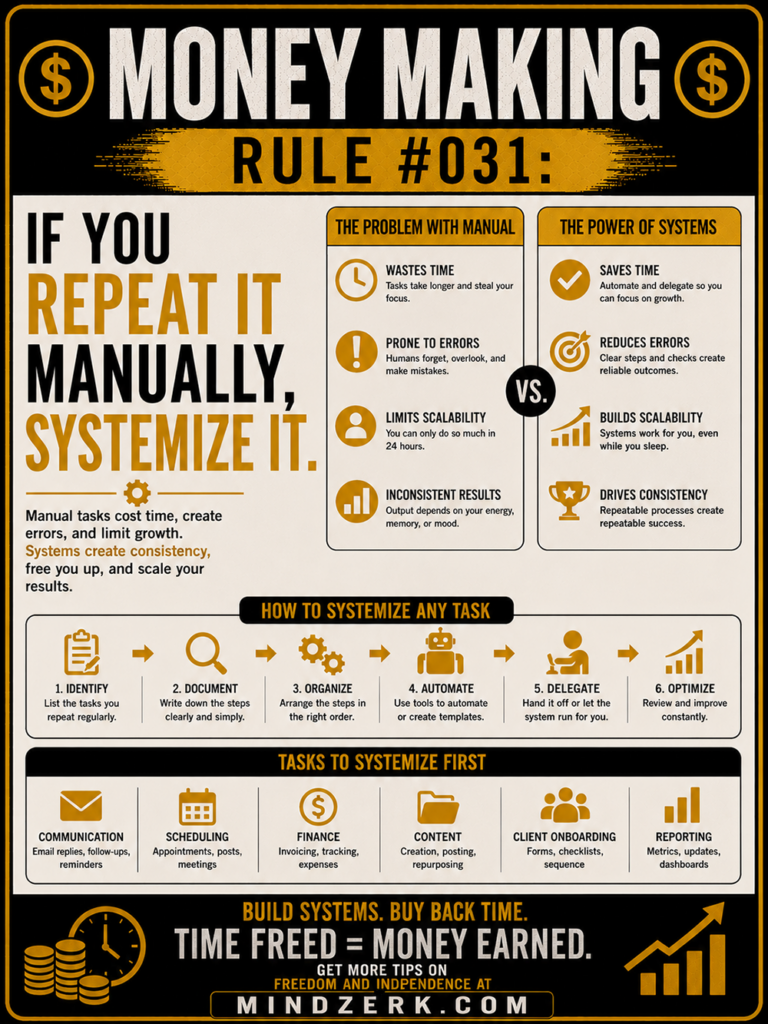
Stop Building Everything Manually
Many people secretly rebuild their business from scratch every week.
That’s exhausting.
If something works:
systemize it.
Turn:
- successful actions
- useful workflows
- repeatable outcomes
…into processes that continue working.
That’s how momentum compounds.
Build Systems Around Real Problems
The best systems solve real problems repeatedly.
Ask:
- What task repeats constantly?
- What wastes time?
- What creates bottlenecks?
- What outcome needs consistency?
- What process depends too heavily on me?
Those are system opportunities.
Complexity Is Usually A Trap
Complicated systems often fail.
Strong systems are:
- simple
- clear
- repeatable
- teachable
- maintainable
Complexity creates fragility.
Simplicity creates scalability.
The Long-Term Difference
People chasing one-off wins usually stay trapped in cycles.
People building systems slowly create:
- leverage
- infrastructure
- compounding results
- operational freedom
That difference becomes enormous over time.
Because systems keep working.
Even when you step away temporarily.
Final Thought
One-off wins feel good.
Systems create freedom.
The people who eventually build wealth usually stop obsessing over:
- random opportunities
- constant hustle
- short-term spikes
…and start building:
- repeatable workflows
- scalable operations
- reliable systems
- compounding processes
Because systems:
- multiply effort
- reduce stress
- create consistency
- survive setbacks
- generate leverage
- scale over time
Stop chasing isolated wins.
Build systems.
That’s how you create:
- freedom
- resilience
- scalability
- wealth
Build once.
Refine forever.
Let the system compound.