
Automation is convenient.
That’s why people love it.
One click and:
- Files sync automatically
- Smart devices respond instantly
- Messages trigger workflows
- Apps talk to each other
- Systems run in the background without effort
But convenience has a cost.
Every automation creates:
- Another connection
- Another permission
- Another dependency
- Another possible point of failure
And every connection is a pathway.
Sometimes a useful one.
Sometimes an exploitable one.
Automation doesn’t just save time.
It hands over information.
Convenience Is Not Privacy
A lot of people confuse:
“Easy”
with
“Safe.”
They are not the same thing.
Modern automation systems are built around:
- Constant connectivity
- Cloud synchronization
- Behavioral tracking
- Data collection
- Cross-platform sharing
That means every “smart” feature often comes bundled with:
- Monitoring
- Logging
- Metadata collection
- Permission creep
- Third-party access
The more automated your life becomes, the larger your exposure surface becomes too.
Every Connected System Leaks Something
Most people think privacy leaks happen through dramatic hacks.
Often they happen quietly through:
- Smart home devices
- Mobile apps
- Cloud accounts
- API integrations
- Automated workflows
- Sync services
- Browser extensions
- Voice assistants
You may not even realize how much data is moving behind the scenes.
Automation often creates invisible pathways between systems.
And invisible pathways are hard to secure.
Smart Devices Are Always Listening
Many “smart” devices constantly collect:
- Usage patterns
- Voice data
- Location information
- Device activity
- Behavioral habits
Even when they are not recording content directly, they often collect metadata.
Metadata matters.
Knowing:
- When you’re home
- When you sleep
- What devices you use
- Who you contact
- Where you go
- What routines you follow
…creates a highly detailed behavioral map.
That information becomes valuable to:
- Advertisers
- Data brokers
- Platforms
- Governments
- Criminals
- Manipulators
Cloud Services Mean Shared Control
Cloud systems are useful.
But cloud convenience comes with tradeoffs.
When your systems rely entirely on cloud infrastructure:
- Your data lives elsewhere
- Access depends on outside companies
- Policies can change instantly
- Accounts can be locked
- Data can be scanned
- Breaches can expose everything at once
People often assume:
“My account is private.”
But cloud-based systems usually involve:
- Logging
- Analytics
- Retention
- Monitoring
- Third-party integrations
Your data may not be as isolated as you think.
Automation Creates Invisible Dependencies
One overlooked danger of automation is:
Dependency stacking.
One workflow depends on:
- Another app
- Another API
- Another cloud account
- Another connected device
Eventually you build chains you barely understand.
When one weak point fails:
- Everything connected becomes vulnerable
This is especially dangerous when people automate systems they never fully learned manually.
Convenience without understanding creates fragility.
Mobile Apps Are Surveillance Portals
Many apps request:
- Contacts
- Camera access
- Microphone access
- Location tracking
- Bluetooth permissions
- File access
- Device identifiers
And most users approve them instantly.
Some apps collect far more than necessary.
Others share data with:
- Advertisers
- Analytics companies
- Third parties
- Data brokers
People install dozens or hundreds of apps and forget they exist.
But old permissions remain active.
Exposure accumulates quietly.
Data Brokers Profit From Your Habits
One of the least understood parts of modern privacy:
Your behavior is a product.
Data brokers collect:
- Shopping habits
- Movement patterns
- Search history
- Device usage
- Financial indicators
- Social connections
Automation accelerates this process because automated systems generate continuous streams of behavioral data.
The more systems connected to your life:
The easier you become to profile.
More Access = More Risk
Every integration increases:
- Attack surface
- Data leakage
- Tracking potential
- System complexity
- Dependency risk
Automation is powerful.
But unrestricted automation creates exposure faster than most people realize.
Especially when users:
- Stop auditing systems
- Forget permissions
- Ignore old accounts
- Blindly trust platforms
- Prioritize convenience over control
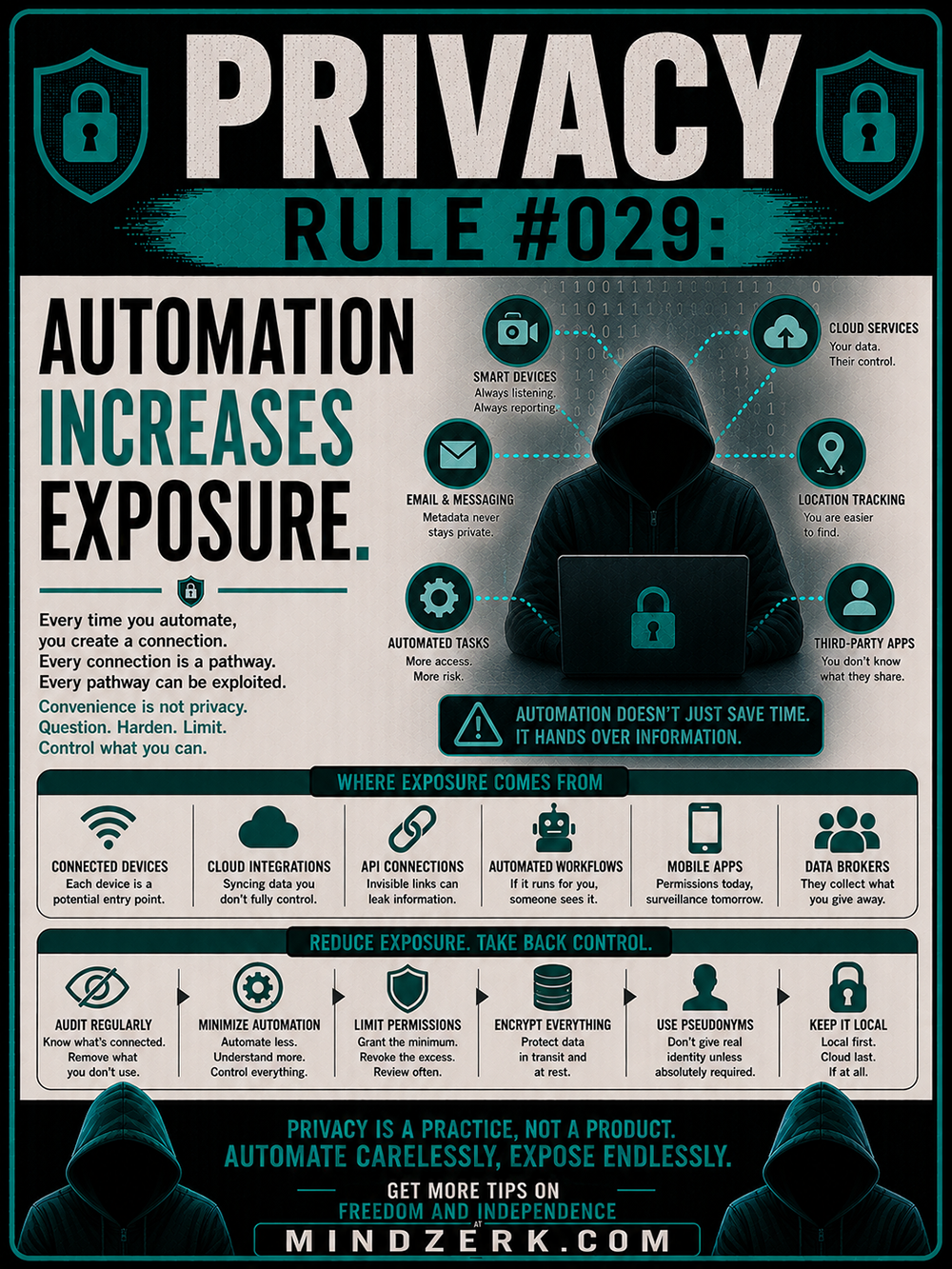
Where Exposure Comes From
Connected Devices
Every connected device becomes a possible entry point.
Cloud Integrations
Syncing data means sharing control.
API Connections
Invisible system-to-system links often leak more information than users realize.
Automated Workflows
If a workflow can access your data:
someone else potentially can too.
Mobile Apps
Permissions accumulate over time.
Data Brokers
What you give away gets collected somewhere.
How To Reduce Exposure
Audit Regularly
Review:
- Devices
- Permissions
- Integrations
- Accounts
- Apps
- Workflows
Remove what you no longer need.
Minimize Automation
Automate carefully.
Not everything should be connected.
The best systems are often selective, not maximal.
Limit Permissions
Grant the minimum access required.
Review permissions frequently.
Encrypt Everything
Protect:
- Data at rest
- Data in transit
- Backups
- Sensitive communication
Encryption reduces damage if exposure occurs.
Use Pseudonyms When Appropriate
Do not tie every service to your full identity unless necessary.
Compartmentalization reduces risk.
Keep Important Data Local
Cloud-first is convenient.
Local-first is resilient.
Not everything belongs online.
Privacy Is A Practice
A lot of people search for:
“The perfect privacy tool.”
But privacy is not a product.
It’s behavior.
Good privacy comes from:
- Awareness
- Discipline
- Reduction
- Verification
- Control
- Simplicity
No app can fix reckless habits.
The Hidden Cost Of Frictionless Systems
Modern technology removes friction.
That sounds positive.
But friction sometimes protects you.
When systems become:
- Instant
- Seamless
- Invisible
- Fully automated
…people stop questioning:
- What’s connected
- What’s shared
- What’s tracked
- Who has access
That blindness creates vulnerability.
The Goal Is Controlled Convenience
You do not need to reject technology completely.
The goal is not paranoia.
The goal is control.
Use automation intentionally.
Understand:
- What connects where
- What data moves
- What permissions exist
- What dependencies are created
Convenience should serve you.
Not expose you.
Final Thought
Automation is powerful.
But every automated connection creates another possible leak.
Every synced device.
Every smart assistant.
Every cloud integration.
Every invisible workflow.
All of it expands exposure.
That does not mean:
“Never automate.”
It means:
Automate consciously.
Question every connection.
Limit unnecessary access.
Reduce complexity.
Retain control where possible.
Because privacy is not something you buy once.
It is something you maintain.
And the more carelessly you automate:
The more endlessly you expose yourself.