

Most people think privacy failures happen through massive hacks.
Hollywood-style breaches.
Elite attackers.
Sophisticated malware.
Sometimes they do.
But more often:
Everything falls apart because of one weak point.
One careless email.
One exposed device.
One overshared detail.
One insecure network.
One trusted person who should not have been trusted.
Privacy is rarely destroyed all at once.
Usually it unravels through small gaps.
And once one piece breaks, the rest often follows fast.
Privacy Is a Chain
A chain is only as strong as its weakest link.
Your privacy works the same way.
You can:
- Use encrypted apps
- Lock down your devices
- Run strong passwords
- Hide your identity
- Protect your location
…but one careless action can bypass all of it.
That is the brutal reality:
One leak compromises everything.
Attackers Look for Weak Points
Most threats do not attack your strongest defenses.
They attack:
- Convenience
- Laziness
- Trust
- Oversharing
- Emotional reactions
- Human mistakes
Why brute-force encryption when:
- Someone reused a password?
- Someone clicked a fake link?
- Someone posted identifying details publicly?
- Someone trusted the wrong person?
Humans are usually easier to exploit than systems.
Oversharing Creates Attack Surfaces
Every detail you share creates another opening.
People often expose:
- Their routines
- Their location
- Their devices
- Their habits
- Their relationships
- Their infrastructure
- Their systems
- Their emotional vulnerabilities
And individually, these details may seem harmless.
Together:
They form a map.
Attackers, scammers, stalkers, manipulators, and bad actors build profiles from fragments.
That is how small leaks become major exposure.
Careless Email Still Destroys People
Email remains one of the biggest security weaknesses.
A single careless email can expose:
- Identities
- Password resets
- Personal information
- Attachments
- Business operations
- Contact networks
Phishing works because people move too fast.
They trust familiarity.
They react emotionally.
They skip verification.
One click can open the door to:
- Data theft
- Account compromise
- Financial loss
- Identity exposure
Exposed Devices Become Open Doors
A single unsecured phone or laptop can compromise entire systems.
Especially if it contains:
- Saved passwords
- Logged-in accounts
- Browser sessions
- Cloud access
- Messages
- Location history
Many people secure their online accounts while completely neglecting physical device security.
That is a mistake.
If attackers get the device:
They often get everything connected to it too.
Unsafe Storage Is Hidden Exposure
People trust cloud storage too casually.
They upload:
- IDs
- Contracts
- Photos
- Notes
- Password backups
- Sensitive documents
…without considering:
- Who controls the service
- What happens during breaches
- Whether accounts can be locked
- Whether files are encrypted properly
Convenience often creates dependency.
Dependency creates vulnerability.
Social Engineering Beats Technical Security
A lot of privacy failures are not technical.
They are psychological.
Social engineering works by exploiting:
- Trust
- Fear
- Urgency
- Ego
- Curiosity
- Emotional reactions
Attackers do not always “hack systems.”
Sometimes they simply:
- Manipulate people
- Ask the right questions
- Pretend to belong
- Build familiarity
- Exploit loose talk
One manipulated person inside your circle can expose everything.
One Leak Creates Cascading Exposure
Privacy failures rarely stay isolated.
One exposed point often leads to:
- Identity exposure
- Location tracking
- Relationship mapping
- Financial targeting
- Device compromise
- Access escalation
Example:
- One email reveals identity
- Identity connects to social media
- Social media reveals location
- Location reveals routines
- Routines reveal vulnerabilities
This is why compartmentalization matters.
Everything connected increases risk.
Trust Is a Major Security Variable
Many privacy failures come from trusting:
- The wrong people
- The wrong platforms
- The wrong services
- The wrong assumptions
Not everyone deserves:
- Access
- Details
- Visibility
- Proximity to your systems
Privacy requires selective trust.
Not blind openness.
Silence Is Protective
Modern culture encourages constant sharing.
Post everything.
Document everything.
Reveal everything.
But silence protects.
Not every thought needs publication.
Not every detail needs exposure.
Not every system needs explanation.
Privacy is often preserved through restraint.
Audit Yourself Regularly
Most people do not know how exposed they already are.
Search yourself.
Review:
- Old accounts
- Public posts
- Metadata
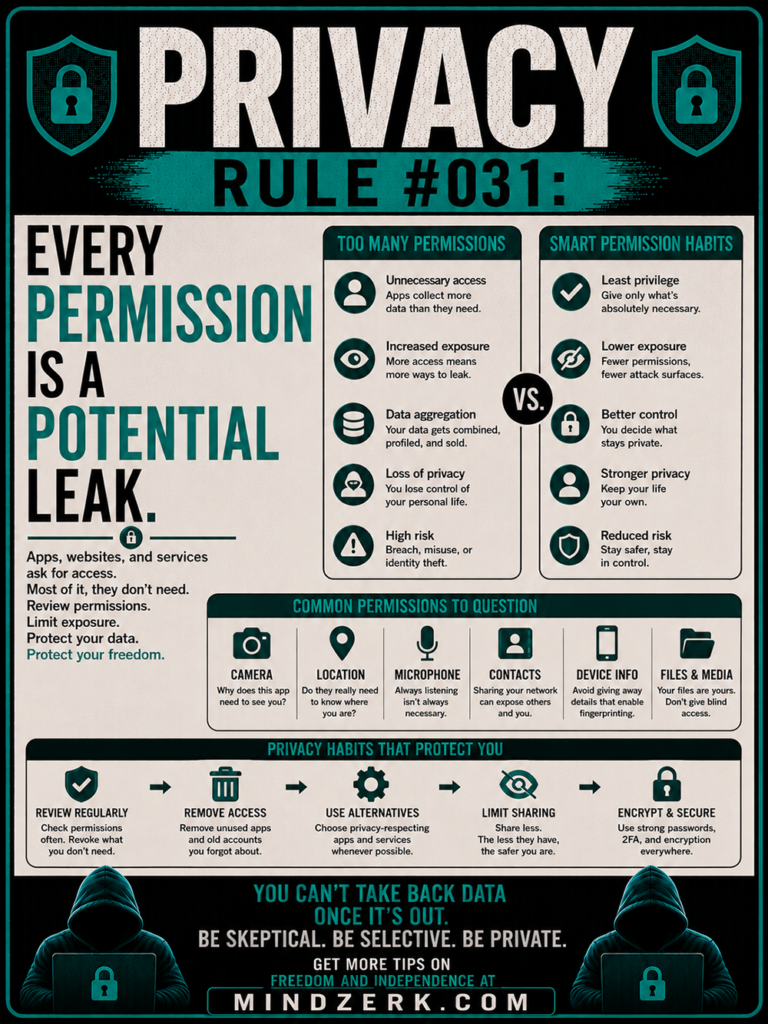
- Device permissions
- Shared files
- Email exposure
- Password reuse
- Social visibility
You may discover:
- Forgotten leaks
- Public data trails
- Open vulnerabilities
- Overshared history
Exposure accumulates slowly over time.
Minimize What Exists
The safest information is often:
Information that was never exposed in the first place.
Reduce:
- Data collection
- Oversharing
- Unnecessary accounts
- Connected services
- Public visibility
- Digital clutter
Every extra system becomes another potential weak point.
Privacy Requires Discipline
Real privacy is not one tool.
It is behavior.
Consistent habits matter:
- Verifying people
- Checking networks
- Securing devices
- Limiting exposure
- Avoiding oversharing
- Maintaining awareness
One careless moment can undo years of caution.
Practical Ways to Reduce Weak Points
1. Share Less
Need-to-know beats public exposure.
2. Separate Systems
Do not connect everything unnecessarily.
3. Secure Devices Aggressively
Physical device access often bypasses other protections.
4. Verify Before Trusting
People are often the weakest link.
5. Audit Exposure Regularly
Check what information is publicly visible.
6. Use Strong Security Habits
Passwords, encryption, updates, backups.
Basic discipline matters.
7. Slow Down Emotionally
Most mistakes happen during urgency or distraction.
Privacy Is Not Paranoia
People mock caution until something goes wrong.
But privacy failures can lead to:
- Financial damage
- Identity theft
- Reputation destruction
- Stalking
- Manipulation
- Real-world danger
Prepared people understand:
Prevention is easier than recovery.
Once information escapes, control becomes difficult or impossible.
Final Thought
You do not need fifty mistakes to compromise privacy.
Sometimes:
- One weak password
- One loose conversation
- One exposed device
- One careless post
- One fake email
…is enough.
Privacy is not built through one perfect tool.
It is built through eliminating weak points consistently.
Because:
One leak can compromise everything. And attackers only need one opening.