
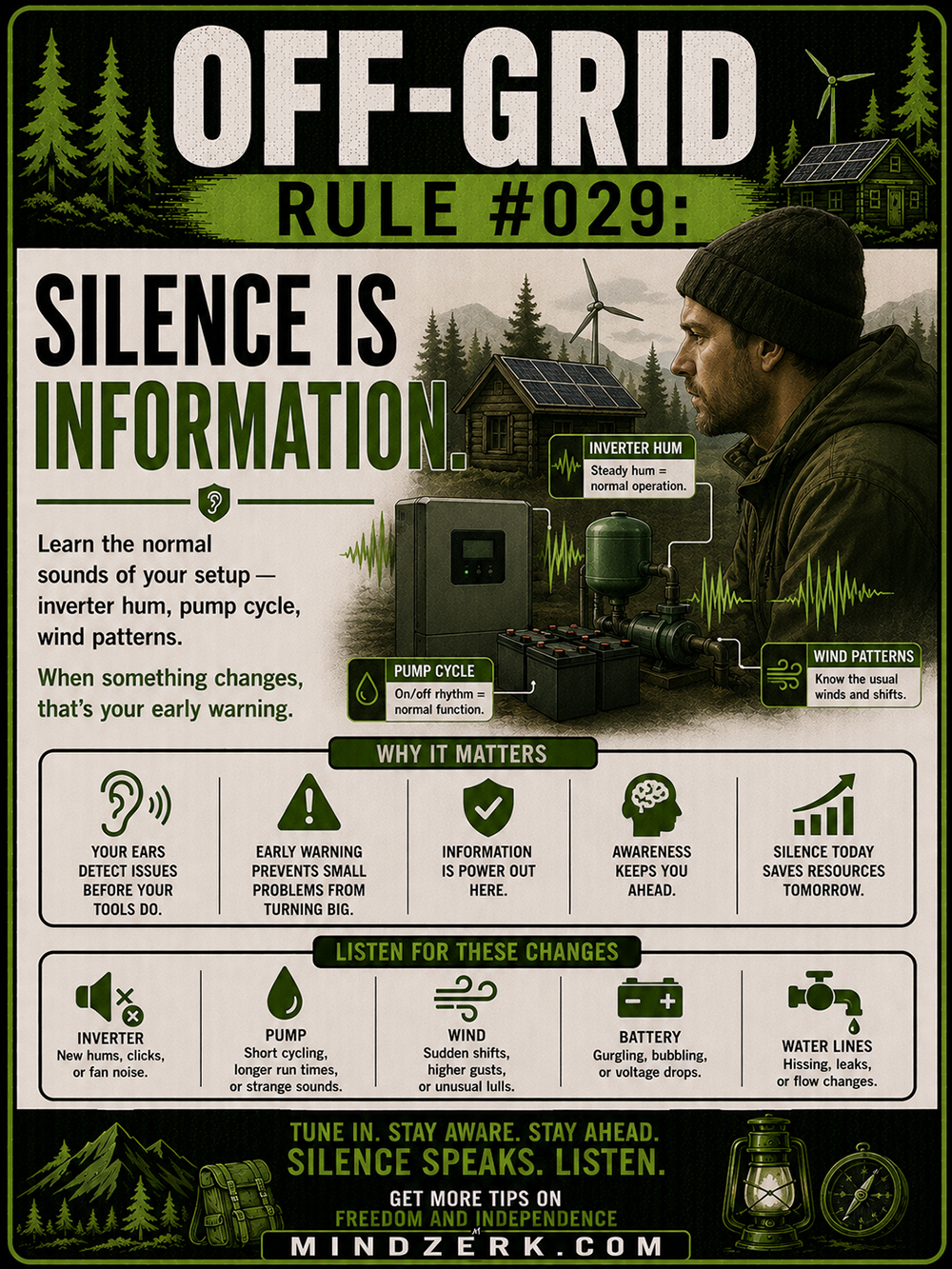

Most people only notice problems after something breaks.
By then?
You’re already reacting.
But experienced off-grid living teaches a different lesson:
Systems talk before they fail.
You just have to learn how to listen.
Every setup has a rhythm:
- The hum of an inverter
- The cycling of a pump
- The creak of a windmill
- The sound of water pressure
- The tone of a generator
- The way batteries behave under load
These patterns become familiar over time.
And when something changes:
That change is information.
Silence is information.
Noise is information.
Timing is information.
Your setup is constantly communicating.
Normal Is Your Baseline
One of the most valuable things you can learn off-grid is:
What “normal” sounds like.
Because once you know normal:
- Strange sounds stand out
- Missing sounds stand out
- Timing changes stand out
- Weakness reveals itself early
This matters because small issues usually become large issues only when ignored.
A tiny pump hiccup today becomes:
- A burned-out pump tomorrow
A slight inverter fan noise becomes:
- A failed cooling system later
A subtle battery voltage fluctuation becomes:
- A dead battery bank eventually
Early awareness prevents expensive surprises.
Modern People Ignore Their Systems
Grid-tied life trains people to:
- Ignore infrastructure
- Assume reliability
- Expect invisible systems
- Depend on automation
Flip a switch.
Water appears.
Heat works.
Power flows.
But off-grid living reconnects you to the reality of systems.
And once you start paying attention:
you realize systems always leave clues before failure.
Your Ears Detect Problems Before Sensors Sometimes
Technology helps.
Meters help.
Apps help.
Monitoring systems help.
But your senses still matter.
Many experienced off-grid people can identify problems simply by hearing:
- A pump cycling too often
- A fan working harder than usual
- An inverter struggling under load
- Water hammer in pipes
- Battery bubbling
- Wind shifting around structures
The human brain is excellent at detecting pattern changes.
Especially when you slow down enough to notice them.
Inverter Hum Tells A Story
Most inverters produce a consistent sound during normal operation.
That hum becomes part of the environment.
But changes matter:
- Louder fans
- Clicking
- Buzzing
- Intermittent noises
- Heat cycling more often
These can signal:
- Overload
- Ventilation problems
- Loose wiring
- Aging components
- Battery stress
If you ignore early warnings, failures escalate.
Pump Cycles Reveal Hidden Problems
Water systems communicate constantly.
Pay attention to:
- Run frequency
- Cycle timing
- Pressure behavior
- Startup sounds
- Shutdown behavior
A pump running more often than usual may indicate:
- Leaks
- Pressure tank problems
- Air intrusion
- Worn components
- Frozen lines
A small sound change today can prevent catastrophic water loss later.
Wind Patterns Matter Too
Off-grid awareness extends beyond equipment.
Environmental sound changes matter.
Learn:
- Normal wind directions
- Seasonal patterns
- Tree movement
- Roof sounds
- Structure creaks
Why?
Because sudden environmental changes can signal:
- Incoming storms
- Dangerous gust patterns
- Structural stress
- Falling tree risks
- Fire behavior changes
Nature gives warnings too.
Batteries Speak Before They Fail
Battery systems often show symptoms before collapse.
Watch and listen for:
- Bubbling
- Heat
- Voltage fluctuations
- Odd smells
- Sudden discharge behavior
- Fan overactivity
- Unusual charging sounds
Ignoring subtle battery changes leads to:
- Reduced lifespan
- Dangerous failures
- Expensive replacements
- Power instability
Battery systems reward attention.
Water Lines Always Give Clues
Water systems rarely fail instantly without warning.
Listen for:
- Hissing
- Dripping
- Flow changes
- Air in lines
- Pressure inconsistencies
These often reveal:
- Leaks
- Frozen sections
- Cracks
- Connection failures
- Sediment buildup
Catching issues early saves:
- Water
- Money
- Energy
- Repair time
Awareness Is A Survival Skill
Off-grid living is not just about equipment.
It’s about awareness.
The more connected you become to your systems:
- The faster you detect problems
- The less damage occurs
- The more reliable your setup becomes
Awareness creates resilience.
Neglect creates emergencies.
Why Silence Matters
Your Ears Detect Issues Early
You often notice changes before alarms do.
Early Warning Prevents Big Problems
Small failures become major failures when ignored.
Information Is Power
Knowing what changed gives you an advantage.
Awareness Keeps You Ahead
Prepared people respond early instead of reacting late.
Small Signals Save Resources
Minor maintenance prevents major replacement costs.
Learn The Soundscape Of Your Setup
Every property has its own “language.”
Learn:
- Generator tone
- Solar inverter rhythm
- Water pump timing
- Wind through trees
- Roof expansion noises
- Battery charging behavior
Over time you develop intuition.
That intuition becomes one of your most valuable tools.
Most Emergencies Start Quietly
Major failures rarely begin dramatically.
Usually they begin with:
- A strange click
- A subtle smell
- A missing hum
- A pressure fluctuation
- A tiny vibration
- A change in rhythm
People miss these signs because:
- They are distracted
- Constantly wearing headphones
- Focused on screens
- Disconnected from their environment
Awareness requires attention.
Technology Can Create Blindness
Ironically, too much monitoring technology can reduce real awareness.
People stop:
- Listening
- Observing
- Inspecting
- Feeling systems directly
They rely entirely on apps and notifications.
But many failures begin before alerts trigger.
Human awareness is still one of the best diagnostic systems available.
Tune In Instead Of Tuning Out
Modern life encourages constant distraction.
Off-grid living rewards presence.
When you:
- Slow down
- Listen carefully
- Observe patterns
- Learn rhythms
…you begin noticing problems early.
That is one of the hidden powers of self-reliance.
Final Thought
Silence is not empty.
Silence contains information.
Your inverter hum.
Your pump cycle.
Your water flow.
Your wind patterns.
Your battery behavior.
All of it tells a story.
And when that story changes:
Pay attention.
Because the people who stay ahead of failures are usually not the people with the most expensive systems.
They are the people who:
- Listen
- Observe
- Learn their environment
- Notice small changes early
Off-grid living is not just about power generation.
It’s about awareness.
Tune in.
Stay aware.
Stay ahead.
Because silence speaks.
And smart people learn how to listen.