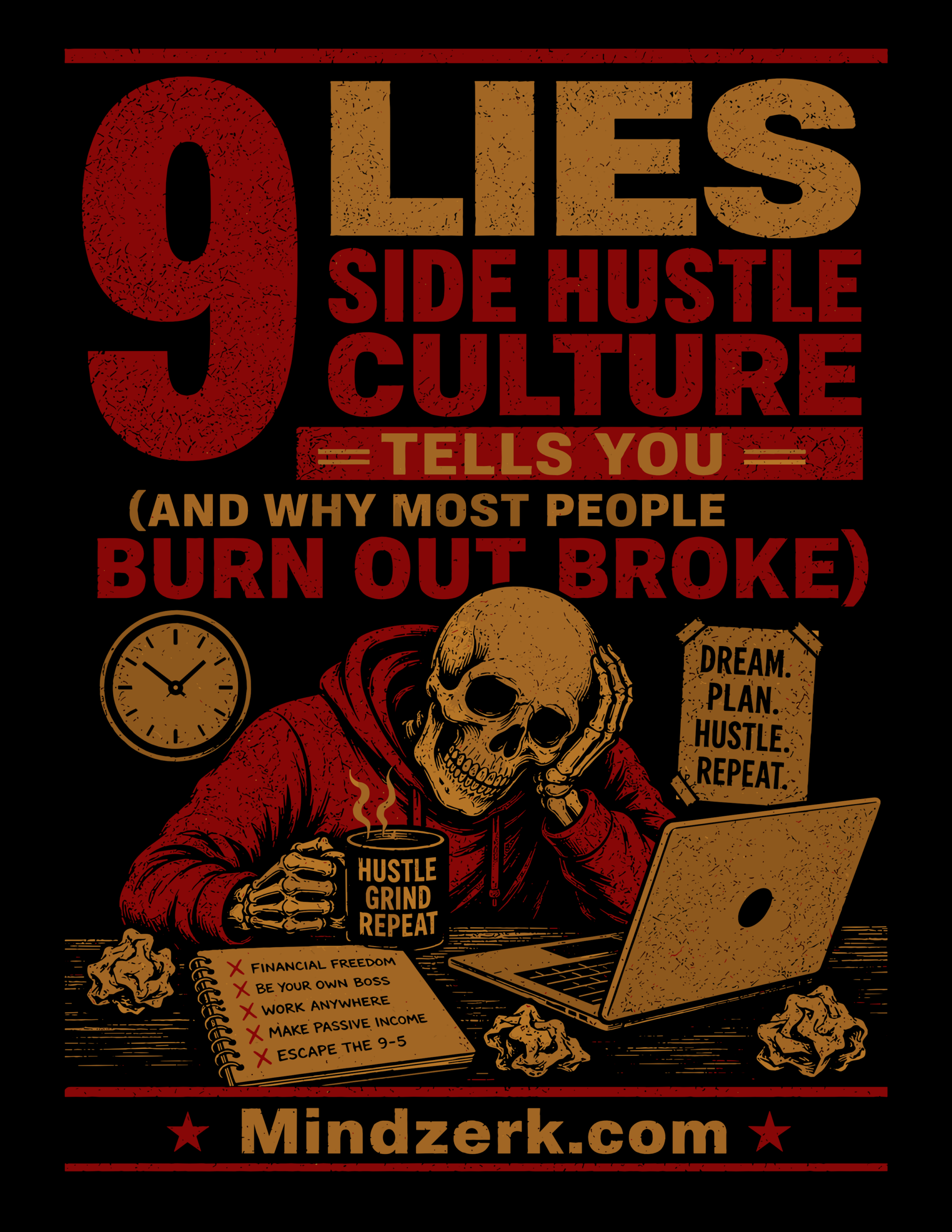

The Hustle Mirage
Side hustle culture makes a simple promise:
Give up your nights. Sacrifice your weekends. Grind now so you can relax later.
It sounds reasonable. Responsible, even.
But look around. Most people chasing side hustles aren’t getting freer. They’re getting tired. They’re juggling half-finished projects, chasing trends that already peaked, and blaming themselves when nothing sticks.
That’s not an accident. It’s the product.
Side hustle culture doesn’t sell income. It sells hope. Hope wrapped in screenshots, blueprints, and “anyone can do this” stories that quietly ignore timing, saturation, and burnout. When it fails, the system doesn’t take the blame—you do. You’re told you didn’t hustle hard enough. You didn’t believe enough. You quit too early.
Here’s the truth most won’t say out loud:
Side hustles aren’t bad. But the way they’re sold is dishonest.
This isn’t about killing ambition or shaming people who want more. It’s about stripping away the myths so you can see what’s actually happening—and decide whether the hustle is serving you, or quietly draining you.
Because if side hustles worked the way they’re advertised, everyone would already be winning.
Lie #1: “Anyone Can Do This”
Side hustle culture loves this line.
“No experience needed.”
“Anyone can start today.”
Technically, it’s true. Anyone can start. That’s not the same as anyone succeeding.
Every side hustle quietly assumes things it never mentions out loud. Time you actually control. A tolerance for uncertainty. The ability to teach yourself new skills without guidance. Comfort with selling, promoting, troubleshooting, and looking stupid in public while you figure it out. These aren’t universal traits. They’re filters.
Two people can follow the same instructions and have completely different outcomes. One has uninterrupted evenings and mental bandwidth. The other is exhausted, distracted, and stressed before they even begin. Side hustle culture pretends those differences don’t matter. They matter more than the idea itself.
When a hustle fails, the blame lands on the person, not the premise. “You didn’t try hard enough.” “You didn’t stay consistent.” The system is never wrong. The individual always is.
That’s the lie.
Not everyone starts from the same place. Not everyone has the same risk tolerance, energy, or margin for error. Pretending otherwise isn’t empowering—it’s misleading. A hustle that works for someone is not proof it will work for anyone.
Lie #2: “It’s Just a Few Hours a Week”
This is where the pitch gets dangerous.
“Work 30 minutes a day.”
“Just a couple hours on the weekend.”
“Fit it in around your life.”
What they’re really selling is the idea that progress happens in fragments. It doesn’t.
Most side hustles are front-loaded with invisible work. Setup. Learning curves. Decision fatigue. Context switching. You’re not just doing the thing—you’re constantly stopping, starting, relearning, and re-orienting. A half hour here and there doesn’t compound. It evaporates.
Fragmented time produces fragmented results. You forget where you left off. You lose momentum. Each session starts with friction instead of flow. Meanwhile, the hustle is quietly demanding more mental space than it admits. You’re thinking about it at dinner. In the shower. When you should be resting.
This is why people feel busy but see nothing move.
Side hustles don’t usually fail because people are lazy. They fail because the work requires deep, contiguous time, while life only offers scraps. Selling it as “just a few hours a week” sets people up to feel broken when the math never adds up.
Lie #3: “Follow This Blueprint”
Side hustle culture is obsessed with blueprints.
Step-by-step systems. Proven frameworks. Exact checklists that promise to remove uncertainty if you just follow the instructions. Do what they did, in the same order, and the outcome will take care of itself.
That’s the fantasy.
Most blueprints only worked under very specific conditions. A certain platform moment. A certain level of audience trust. A window before saturation set in. By the time you see the “system,” the environment that made it profitable is already gone.
What’s left is imitation without context.
Blueprints also hide judgment calls. Decisions about positioning, timing, pricing, and risk get rewritten as mechanical steps. When the steps stop working, there’s no guidance—just silence or upsells. The framework can’t think for you.
Frameworks can be useful. They can shorten learning curves and spark ideas. But they don’t replace awareness. They don’t adapt when conditions change. And they don’t protect you from copying something that only worked once, for someone else, at the exact right moment.
Following a blueprint feels safe. It feels efficient. But most of the time, it just keeps you walking someone else’s expired path.
Lie #4: “More Hustles = More Money”
Side hustle culture loves to talk about “stacking income streams.”
Affiliate links on top of freelancing. A course on top of a newsletter. Merch layered onto content layered onto ads. The logic sounds solid: more inputs should mean more output.
In practice, it usually means more dilution.
Each new hustle competes for the same limited resources—attention, energy, and follow-through. Instead of one thing getting enough momentum to work, you end up with five things hovering just below viability. Nothing compounds. Everything resets.
This is especially brutal in the early stages. Most people don’t need diversification. They need traction. One system that’s simple enough to survive bad weeks and boring enough to repeat. Stacking too early turns learning into juggling.
The uncomfortable truth is that multiple hustles don’t protect you when none of them are stable. They just multiply decision-making and fatigue. Focus isn’t a limitation at the beginning—it’s leverage.
More hustles don’t automatically mean more money. Most of the time, they just mean more exits you never fully walked through.
Lie #5: “If It Didn’t Work, You Didn’t Want It Bad Enough”
This is the guilt lever.
When a side hustle stalls or dies, the story flips fast. It’s no longer about market conditions, timing, or structural flaws. It becomes personal. You didn’t want it badly enough. You weren’t consistent. You lacked discipline.
This framing is convenient because it protects the system. If failure is always a mindset problem, the hustle itself is never questioned.
But plenty of side hustles are broken by design. Some rely on platforms that quietly change the rules. Others only work at low competition levels that no longer exist. Many depend on constant novelty, meaning the moment you catch up, the edge is gone. No amount of “wanting it” fixes that.
Persistence matters—but only when it’s paired with feedback. Grinding a flawed model harder doesn’t make it stronger. It just drains you faster.
Quitting isn’t always weakness. Sometimes it’s pattern recognition. Sometimes it’s refusing to sink more time into something that isn’t improving. Treating every exit as a character flaw trains people to stay trapped in systems that aren’t paying them back.
Wanting something badly doesn’t make it viable. And walking away from a dead end doesn’t mean you failed.
Lie #6: “You’ll Love the Grind”
Side hustle culture romanticizes suffering.
Late nights become proof of commitment. Burnout gets reframed as passion. If you’re exhausted, that just means you’re “doing it right.” Love the grind, and the rewards will come.
That sounds motivating until you live inside it.
Constant grind doesn’t sharpen people. It dulls them. Creativity drops. Judgment erodes. Small problems feel massive. What starts as excitement turns into quiet resentment, not because the work is hard, but because it never eases up. There’s no signal that it’s paying off—only more effort demanded.
Most people don’t quit because they’re weak. They quit because the grind has no end state. The work doesn’t get simpler. The stress doesn’t reduce. The promised future never arrives.
Sustainable income doesn’t feel like a heroic struggle. It feels repetitive. Sometimes boring. Predictable enough that your nervous system can relax. When a hustle requires you to “love the grind” just to survive it, that’s not a feature. It’s a warning.
If enjoying misery is the prerequisite, the problem isn’t your attitude. It’s the model.
Lie #7: “Once It Works, You’re Free”
This is the payoff promise.
Endure the grind now, and freedom waits on the other side. No boss. No schedule. No limits. Just you, your hustle, and total control.
What rarely gets mentioned is what “working” actually looks like.
Many side hustles don’t eliminate work—they repackage it. You trade a manager for metrics. A schedule for notifications. A paycheck for volatility. Instead of one boss, you answer to platforms, algorithms, customers, and constant maintenance. The hustle doesn’t stop asking for attention just because it’s profitable.
For a lot of people, the result isn’t freedom. It’s another job with worse boundaries.
Real freedom comes from control, not scale. Control over pace. Over obligations. Over how fragile the system is when you step away. A hustle that collapses the moment you stop feeding it hasn’t bought you independence. It’s just changed who applies the pressure.
“Once it works” is an incomplete sentence.
The real question is: works for who, and at what cost?
Lie #8: “Everyone Else Is Winning”
Side hustle culture runs on comparison.
Screenshots of dashboards. Income claims. Lifestyle shots carefully framed to suggest momentum, freedom, and ease. Scroll long enough and it starts to feel like you’re the only one stuck while everyone else figured it out.
That feeling is engineered.
What you’re seeing is survivorship bias mixed with performance. The wins get amplified. The stalls disappear. The quiet failures don’t post updates announcing they gave up after six months and $2,000 in tools. They just vanish.
Most side hustles don’t explode. They sputter. They hover under a few hundred dollars a month. They stall when life gets busy. That reality doesn’t convert well, so it stays invisible.
Constant exposure to highlight reels warps judgment. You start measuring yourself against outcomes without seeing the full timeline, the hidden costs, or the attempts that failed first. Silence starts to feel like failure when it’s often just normal progress.
Visibility is not proof of success. And the absence of noise doesn’t mean you’re losing. It usually means you’re seeing reality instead of the performance.
Lie #9: “You Need to Hustle to Be Secure”
This is the fear-based lie that keeps everything running.
You’re told that one income is reckless. That standing still is dangerous. That if you’re not always building something on the side, you’re falling behind. Hustling becomes framed as responsibility, not choice.
In reality, constant hustling often creates the opposite of security.
When you’re always chasing the next thing, you never go deep enough to stabilize anything. Skills stay shallow. Systems stay fragile. Every new idea resets the clock. The anxiety never drops because nothing feels solid—only temporary.
Real security usually comes from boring foundations. Predictable skills. Low overhead. Systems that don’t panic when you step away for a week. It comes from understanding how money actually moves in your life, not from stacking unfinished projects out of fear.
Hustle culture treats motion as safety. But movement without direction is just noise.
You don’t become secure by exhausting yourself in ten directions. You become secure by building a few things you actually understand, control, and can maintain without burning out. Chaos feels productive. Stability is quieter—and far more durable.
The Quiet Alternative
Side hustles aren’t the enemy. Plenty of people use them well. The problem is the culture built around them—the myths, the pressure, and the constant implication that exhaustion is the price of security.
Hustle culture trains people to confuse motion with progress. To mistake suffering for commitment. To believe that if they just push harder, something will eventually give. Usually, what gives is their energy, their focus, or their sense of control.
There’s a quieter alternative.
Income doesn’t have to be loud, scalable, or impressive to work. It can be small. Local. Repetitive. Built from skills you already have and systems you can actually maintain. It can grow slowly without demanding your nervous system as collateral.
The goal isn’t to hustle harder or collect more streams. It’s to build income that fits inside your life instead of consuming it. Income that survives boring weeks. Income that doesn’t collapse when you stop performing online.
Side hustle culture sells escape. What most people really need is stability, leverage, and room to breathe. When you strip away the lies, that path becomes visible—and it looks a lot less like a grind, and a lot more like control.