

Most people share too much.
Too much about:
- Their routines
- Their tools
- Their schedules
- Their business operations
- Their locations
- Their infrastructure
- Their plans
- Their vulnerabilities
And they do it publicly.
Online.
Permanently.
Then they wonder why they become targets for:
- Scams
- Manipulation
- Surveillance
- Social engineering
- Harassment
- Data theft
- Real-world security problems
Here’s the reality:
Information is power.
The less people know about your systems, the harder you are to disrupt.
Privacy is not paranoia.
It’s operational discipline.
Oversharing Creates Weakness
Modern culture rewards exposure.
People are encouraged to:
- Document everything
- Share every update
- Post every purchase
- Reveal every process
- Announce every move
- Publicize every success
But visibility has costs.
Every detail you reveal becomes usable information.
Maybe not today.
Maybe not by everyone.
But eventually, somebody connects the dots.
Your Systems Matter
A “system” is anything that supports your life or operations.
That includes:
- Your income systems
- Your communication channels
- Your routines
- Your security setup
- Your devices
- Your software stack
- Your storage methods
- Your backup plans
- Your travel patterns
- Your home infrastructure
- Your business workflows
When people understand your systems, they understand:
- How to influence you
- How to pressure you
- How to disrupt you
- How to exploit weaknesses
Loose information creates attack surfaces.
Most Attacks Start With Information
Very few attacks begin with advanced hacking.
Most begin with:
- Observation
- Social engineering
- Pattern recognition
- Metadata
- Public information
- Casual conversations
- Oversharing
Attackers often do not “break in.”
They collect clues.
Then they assemble a profile.
Social Engineering Is the Real Threat
People think privacy risks come mostly from technology.
Often the biggest weakness is human behavior.
Someone learns:
- Your work schedule
- Your tools
- Your habits
- Your interests
- Your stress points
- Your relationships
- Your routines
Then they use that information to:
- Build trust
- Impersonate people
- Manipulate conversations
- Trick you into revealing more
- Exploit timing and predictability
The more someone knows about your systems, the easier manipulation becomes.
Silence Protects Your Edge
Not everything needs to be shared.
You do not need to publicly explain:
- Every platform you use
- Every automation you run
- Every revenue source
- Every privacy measure
- Every security method
- Every backup plan
- Every location
- Every future move
The internet trains people to seek validation through exposure.
But disciplined privacy creates resilience.
Predictability Creates Vulnerability
Patterns expose you.
If people can predict:
- Where you are
- When you travel
- When you sleep
- What tools you use
- When you launch
- How you operate
…they can prepare around those patterns.
Unpredictability creates friction for attackers.
Predictability makes targeting easier.
Less Information = Less Risk
A good privacy mindset is simple:
Only share what is necessary.
Not what is emotionally satisfying.
Not what gains temporary attention.
Not what feeds algorithms.
Necessary.
That shift alone dramatically reduces exposure.
What Others Know = What They Can Use
Every revealed detail becomes a possible lever.
Targeted Attacks
Attackers use information to:
- Identify weaknesses
- Craft believable scams
- Build impersonation attempts
- Exploit timing
Physical Risk
Posting:
- Locations
- Travel schedules
- Expensive equipment
- Daily routines
…can create real-world consequences.
Especially when information compounds over time.
Digital Exposure
Publicly revealing:
- Infrastructure
- Software stacks
- Hosting setups
- Devices
- Security habits
…helps attackers map your environment.
Loss of Freedom
The more dependent your systems become on outside approval, validation, and exposure, the less control you maintain.
Privacy preserves autonomy.
Practice Information Discipline
Privacy is often less about technology and more about restraint.
Share on a Need-to-Know Basis
Ask:
- Does this need to be public?
- Does this help me?
- What risk does this create?
- Who benefits from this information?
Not every thought needs distribution.
Avoid Public Bragging
Bragging attracts:
- Jealousy
- Competitors
- Opportunists
- Scammers
- Attention you do not control
Quiet systems survive longer.
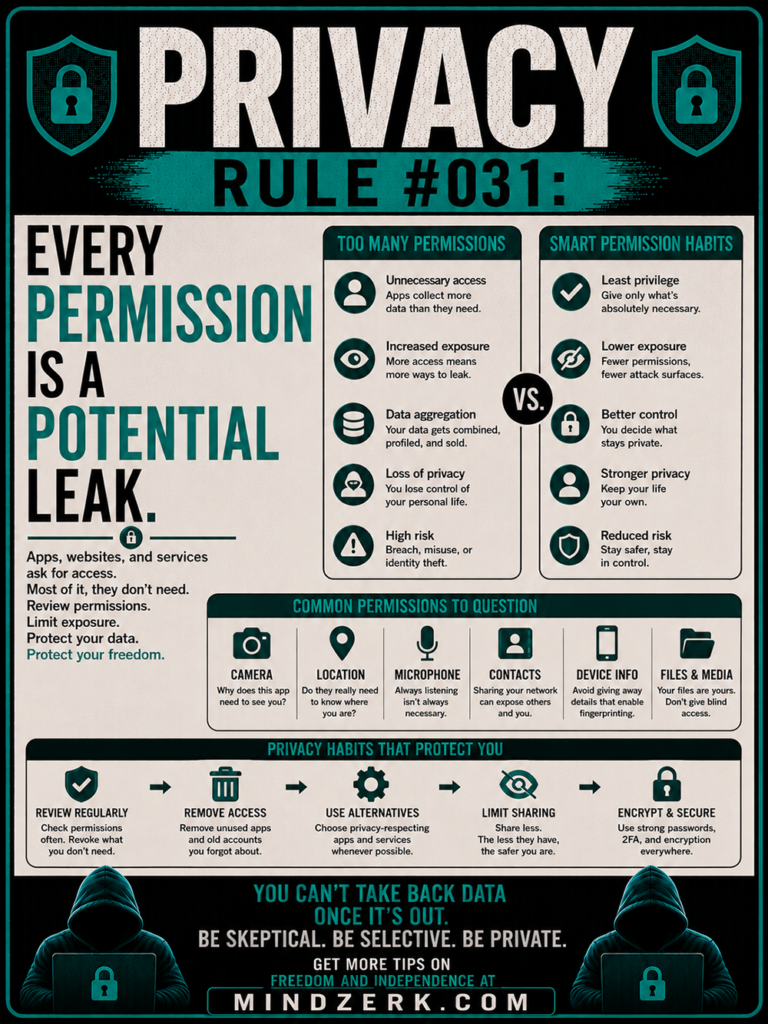
Remove Metadata and Identifiers
Photos, files, and posts often reveal:
- GPS data
- Device details
- Timestamps
- Locations
- Patterns
People expose more than they realize.
Separate Identities
Not every activity should connect together.
Separate:
- Work identities
- Personal identities
- Experimental projects
- Communications
- Accounts
Compartmentalization limits damage.
Review Privacy Settings Regularly
Platforms constantly change settings.
Assume:
- Defaults are not in your favor
- Data collection expands over time
- Convenience usually costs privacy
Audit regularly.
Build Private, Resilient Systems
Privacy improves when systems become:
- More independent
- More isolated
- Less centralized
- Less public
Self-Host When Possible
The more infrastructure you control:
- The more freedom you maintain
- The less exposure you face
- The harder it becomes to remove or manipulate you
Ownership matters.
Use Encrypted Communication
Sensitive discussions should not happen casually on public platforms.
Use secure tools when privacy matters.
Keep Critical Information Offline
Not everything belongs in the cloud.
Store:
- Backups
- Logs
- Recovery plans
- Important documents
…in protected offline locations when possible.
Segment Your Systems
Do not connect everything unnecessarily.
Separate:
- Devices
- Networks
- Accounts
- Data stores
- Operations
Isolation prevents cascading failures.
Expect Scrutiny
Assume:
- Systems are monitored
- Data is collected
- Platforms are analyzed
- Public activity is archived
That mindset creates stronger operational habits.
Privacy Is About Control
The goal is not disappearing completely.
The goal is maintaining control over:
- Your information
- Your operations
- Your systems
- Your risks
- Your freedom
Oversharing transfers control outward.
Privacy pulls control back inward.
Final Thought
Modern systems encourage constant exposure because exposed people are easier to:
- Track
- Influence
- Sell to
- Manipulate
- Profile
But freedom requires boundaries.
You do not owe the public a blueprint of your life.
You do not need to advertise your systems.
You do not need to explain every move.
The less unnecessary information people have about your systems, the harder you are to target, pressure, or disrupt.
So:
- Share less
- Reveal less
- Protect more
- Think long-term
- Build quietly
- Stay resilient
Because:
What others know about your systems can eventually be used against them.
Protect the systems. Protect the freedom.